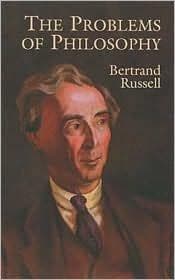
Knowledge, Theory of; Metaphysics; Philosophy -- Introductions
But let us imagine some insistent Socrates, who, whatever reason we
give him, continues to demand a reason for the reason. We must sooner
or later, and probably before very long, be driven to a point where we
cannot find any further reason, and where it becomes almost certain that
no further reason is even theoretically discoverable. Starting with the
common beliefs of daily life, we can be driven back from point to point,
until we come to some general principle, or some instance of a general
principle, which seems luminously evident, and is not itself capable
of being deduced from anything more evident. In most questions of
daily life, such as whether our food is likely to be nourishing and not
poisonous, we shall be driven back to the inductive principle, which we
discussed in Chapter VI. But beyond that, there seems to be no further
regress. The principle itself is constantly used in our reasoning,
sometimes consciously, sometimes unconsciously; but there is no
reasoning which, starting from some simpler self-evident principle,
leads us to the principle of induction as its conclusion. And the same
holds for other logical principles. Their truth is evident to us, and we
employ them in constructing demonstrations; but they themselves, or at
least some of them, are incapable of demonstration.
Self-evidence, however, is not confined to those among general
principles which are incapable of proof. When a certain number of
logical principles have been admitted, the rest can be deduced from
them; but the propositions deduced are often just as self-evident as
those that were assumed without proof. All arithmetic, moreover, can
be deduced from the general principles of logic, yet the simple
propositions of arithmetic, such as 'two and two are four', are just as
self-evident as the principles of logic.
It would seem, also, though this is more disputable, that there are some
self-evident ethical principles, such as 'we ought to pursue what is
good'.
It should be observed that, in all cases of general principles,
particular instances, dealing with familiar things, are more evident
than the general principle. For example, the law of contradiction states
that nothing can both have a certain property and not have it. This is
evident as soon as it is understood, but it is not so evident as that a
particular rose which we see cannot be both red and not red. (It is of
course possible that parts of the rose may be red and parts not red, or
that the rose may be of a shade of pink which we hardly know whether to
call red or not; but in the former case it is plain that the rose as a
whole is not red, while in the latter case the answer is theoretically
definite as soon as we have decided on a precise definition of 'red'.)
It is usually through particular instances that we come to be able to
see the general principle. Only those who are practised in dealing with
abstractions can readily grasp a general principle without the help of
instances.
Public-domain text, read in full here on John Shaqi.
Reviews
Reviews
No reviews yet
Be the first to share your thoughts on this work.
Elsewhere in the archive
Join the Discussion
Join the discussion
Sign in to leave a comment or review.
Sign InorCreate an account