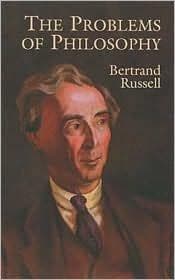
Knowledge, Theory of; Metaphysics; Philosophy -- Introductions
It seems, however, highly probable that two different notions are
combined in 'self-evidence' as above explained; that one of them,
which corresponds to the highest degree of self-evidence, is really an
infallible guarantee of truth, while the other, which corresponds to
all the other degrees, does not give an infallible guarantee, but only a
greater or less presumption. This, however, is only a suggestion, which
we cannot as yet develop further. After we have dealt with the nature
of truth, we shall return to the subject of self-evidence, in connexion
with the distinction between knowledge and error.
CHAPTER XII. TRUTH AND FALSEHOOD
Our knowledge of truths, unlike our knowledge of things, has an
opposite, namely _error_. So far as things are concerned, we may know
them or not know them, but there is no positive state of mind which can
be described as erroneous knowledge of things, so long, at any rate,
as we confine ourselves to knowledge by acquaintance. Whatever we are
acquainted with must be something; we may draw wrong inferences from
our acquaintance, but the acquaintance itself cannot be deceptive. Thus
there is no dualism as regards acquaintance. But as regards knowledge of
truths, there is a dualism. We may believe what is false as well as
what is true. We know that on very many subjects different people
hold different and incompatible opinions: hence some beliefs must be
erroneous. Since erroneous beliefs are often held just as strongly
as true beliefs, it becomes a difficult question how they are to be
distinguished from true beliefs. How are we to know, in a given case,
that our belief is not erroneous? This is a question of the very
greatest difficulty, to which no completely satisfactory answer is
possible. There is, however, a preliminary question which is rather less
difficult, and that is: What do we _mean_ by truth and falsehood? It is
this preliminary question which is to be considered in this chapter. In
this chapter we are not asking how we can know whether a belief is true
or false: we are asking what is meant by the question whether a belief
is true or false. It is to be hoped that a clear answer to this question
may help us to obtain an answer to the question what beliefs are
true, but for the present we ask only 'What is truth?' and 'What is
falsehood?' not 'What beliefs are true?' and 'What beliefs are false?'
It is very important to keep these different questions entirely
separate, since any confusion between them is sure to produce an answer
which is not really applicable to either.
There are three points to observe in the attempt to discover the nature
of truth, three requisites which any theory must fulfil.
Public-domain text, read in full here on John Shaqi.
Reviews
Reviews
No reviews yet
Be the first to share your thoughts on this work.
Elsewhere in the archive
Join the Discussion
Join the discussion
Sign in to leave a comment or review.
Sign InorCreate an account