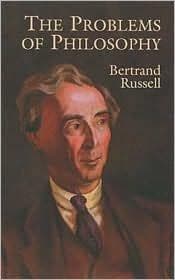
Knowledge, Theory of; Metaphysics; Philosophy -- Introductions
(1) Our theory of truth must be such as to admit of its opposite,
falsehood. A good many philosophers have failed adequately to satisfy
this condition: they have constructed theories according to which all
our thinking ought to have been true, and have then had the greatest
difficulty in finding a place for falsehood. In this respect our theory
of belief must differ from our theory of acquaintance, since in the case
of acquaintance it was not necessary to take account of any opposite.
(2) It seems fairly evident that if there were no beliefs there could
be no falsehood, and no truth either, in the sense in which truth is
correlative to falsehood. If we imagine a world of mere matter, there
would be no room for falsehood in such a world, and although it would
contain what may be called 'facts', it would not contain any truths, in
the sense in which truths are things of the same kind as falsehoods.
In fact, truth and falsehood are properties of beliefs and statements:
hence a world of mere matter, since it would contain no beliefs or
statements, would also contain no truth or falsehood.
(3) But, as against what we have just said, it is to be observed that
the truth or falsehood of a belief always depends upon something which
lies outside the belief itself. If I believe that Charles I died on the
scaffold, I believe truly, not because of any intrinsic quality of my
belief, which could be discovered by merely examining the belief, but
because of an historical event which happened two and a half centuries
ago. If I believe that Charles I died in his bed, I believe falsely: no
degree of vividness in my belief, or of care in arriving at it, prevents
it from being false, again because of what happened long ago, and not
because of any intrinsic property of my belief. Hence, although truth
and falsehood are properties of beliefs, they are properties dependent
upon the relations of the beliefs to other things, not upon any internal
quality of the beliefs.
The third of the above requisites leads us to adopt the view--which has
on the whole been commonest among philosophers--that truth consists in
some form of correspondence between belief and fact. It is, however, by
no means an easy matter to discover a form of correspondence to which
there are no irrefutable objections. By this partly--and partly by the
feeling that, if truth consists in a correspondence of thought with
something outside thought, thought can never know when truth has been
attained--many philosophers have been led to try to find some definition
of truth which shall not consist in relation to something wholly outside
belief. The most important attempt at a definition of this sort is the
theory that truth consists in _coherence_. It is said that the mark of
falsehood is failure to cohere in the body of our beliefs, and that it
is the essence of a truth to form part of the completely rounded system
which is The Truth.
Public-domain text, read in full here on John Shaqi.
Reviews
Reviews
No reviews yet
Be the first to share your thoughts on this work.
Elsewhere in the archive
Join the Discussion
Join the discussion
Sign in to leave a comment or review.
Sign InorCreate an account