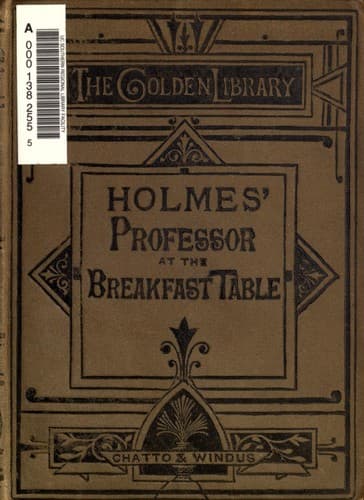
The Professor at the Breakfast-TableHolmes, Oliver Wendell
General
The Professor at the Breakfast-Table
Holmes, Oliver Wendell
American fiction -- 19th century; Conversation -- Fiction; Poetry
Of course you don't suppose that I have any foolish superstitions about
the matter,--I, the Professor, who have seen enough to take all that
nonsense out of any man's head! It is not our beliefs that frighten us
half so much as our fancies. A man not only believes, but knows he runs
a risk, whenever he steps into a railroad car; but it does n't worry him
much. On the other hand, carry that man across a pasture a little way
from some dreary country-village, and show him an old house where there
were strange deaths a good many years ago, and there are rumors of ugly
spots on the walls,--the old man hung himself in the garret, that is
certain, and ever since the country-people have called it “the haunted
house,”--the owners have n't been able to let it since the last tenants
left on account of the noises,--so it has fallen into sad decay, and the
moss grows on the rotten shingles of the roof, and the clapboards have
turned black, and the windows rattle like teeth that chatter with fear,
and the walls of the house begin to lean as if its knees were shaking,
--take the man who did n't mind the real risk of the cars to that old
house, on some dreary November evening, and ask him to sleep there
alone,--how do you think he will like it? He doesn't believe one word
of ghosts,--but then he knows, that, whether waking or sleeping, his
imagination will people the haunted chambers with ghostly images. It is
not what we believe, as I said before, that frightens us commonly,
but what we conceive. A principle that reaches a good way if I am not
mistaken. I say, then, that, if these odd sounds coming from the Little
Gentleman's chamber sometimes make me nervous, so that I cannot get
to sleep, it is not because I suppose he is engaged in any unlawful or
mysterious way. The only wicked suggestion that ever came into my head
was one that was founded on the landlady's story of his having a pile
of gold; it was a ridiculous fancy; besides, I suspect the story of
sweating gold was only one of the many fables got up to make the Jews
odious and afford a pretext for plundering them. As for the sound like a
woman laughing and crying, I never said it was a woman's voice; for, in
the first place, I could only hear indistinctly; and, secondly, he may
have an organ, or some queer instrument or other, with what they call
the vox humana stop. If he moves his bed round to get away from the
window, or for any such reason, there is nothing very frightful in that
simple operation. Most of our foolish conceits explain themselves in
some such simple way. And, yet, for all that, I confess, that, when I
woke up the other evening, and heard, first a sweet complaining cry, and
then footsteps, and then the dragging sound,--nothing but his bed, I am
quite sure,--I felt a stirring in the roots of my hair as the feasters
did in Keats's terrible poem of “Lamia.”
Public-domain text, read in full here on John Shaqi.
Reviews
Reviews
No reviews yet
Be the first to share your thoughts on this work.
Elsewhere in the archive
Join the Discussion
Join the discussion
Sign in to leave a comment or review.
Sign InorCreate an account