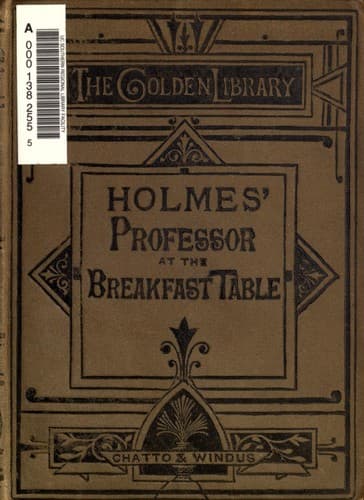
The Professor at the Breakfast-TableHolmes, Oliver Wendell
General
The Professor at the Breakfast-Table
Holmes, Oliver Wendell
American fiction -- 19th century; Conversation -- Fiction; Poetry
The young man John, for instance, asked me to come up one day and try
some “old Burbon,” which he said was A 1. On asking him what was the
number of his room, he answered, that it was forty-'leven, sky-parlor
floor, but that I shouldn't find it, if he did n't go ahead to show me
the way. I followed him to his habitat, being very willing to see in
what kind of warren he burrowed, and thinking I might pick up something
about the boarders who had excited my curiosity.
Mighty close quarters they were where the young man John bestowed
himself and his furniture; this last consisting of a bed, a chair,
a bureau, a trunk, and numerous pegs with coats and “pants” and
“vests,”--as he was in the habit of calling waist-coats and pantaloons
or trousers,--hanging up as if the owner had melted out of them.
Several prints were pinned up unframed,--among them that grand national
portrait-piece, “Barnum presenting Ossian E. Dodge to Jenny Lind,” and a
picture of a famous trot, in which I admired anew the cabalistic air of
that imposing array of expressions, and especially the Italicized word,
“Dan Mace names b. h. Major Slocum,” and “Hiram Woodruff names g. m.
Lady Smith.” “Best three in five. Time: 2.40, 2.46, 2.50.”
That set me thinking how very odd this matter of trotting horses is, as
an index of the mathematical exactness of the laws of living mechanism.
I saw Lady Suffolk trot a mile in 2.26. Flora Temple has trotted close
down to 2.20; and Ethan Allen in 2.25, or less. Many horses have trotted
their mile under 2.30; none that I remember in public as low down as
2.20. From five to ten seconds, then, in about a hundred and sixty is
the whole range of the maxima of the present race of trotting horses.
The same thing is seen in the running of men. Many can run a mile in
five minutes; but when one comes to the fractions below, they taper down
until somewhere about 4.30 the maximum is reached. Averages of masses
have been studied more than averages of maxima and minima. We know from
the Registrar-General's Reports, that a certain number of children--say
from one to two dozen--die every year in England from drinking hot water
out of spouts of teakettles. We know, that, among suicides, women and
men past a certain age almost never use fire-arms. A woman who has made
up her mind to die is still afraid of a pistol or a gun. Or is it that
the explosion would derange her costume?
Public-domain text, read in full here on John Shaqi.
Reviews
Reviews
No reviews yet
Be the first to share your thoughts on this work.
Elsewhere in the archive
Join the Discussion
Join the discussion
Sign in to leave a comment or review.
Sign InorCreate an account