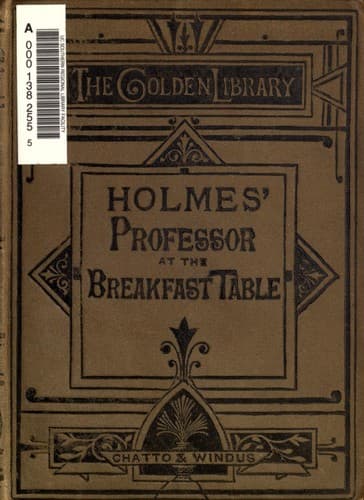
The Professor at the Breakfast-TableHolmes, Oliver Wendell
General
The Professor at the Breakfast-Table
Holmes, Oliver Wendell
American fiction -- 19th century; Conversation -- Fiction; Poetry
Not to give up all the questions I was determined to solve, I made
an attempt also to work into the Little Gentleman's chamber. For this
purpose, I kept him in conversation, one morning, until he was just
ready to go up-stairs, and then, as if to continue the talk, followed
him as he toiled back to his room. He rested on the landing and faced
round toward me. There was something in his eye which said, Stop there!
So we finished our conversation on the landing. The next day, I mustered
assurance enough to knock at his door, having a pretext ready.--No
answer.--Knock again. A door, as if of a cabinet, was shut softly and
locked, and presently I heard the peculiar dead beat of his thick-soled,
misshapen boots. The bolts and the lock of the inner door were
unfastened,--with unnecessary noise, I thought,--and he came into the
passage. He pulled the inner door after him and opened the outer one
at which I stood. He had on a flowered silk dressing-gown, such as
“Mr. Copley” used to paint his old-fashioned merchant-princes in; and
a quaint-looking key in his hand. Our conversation was short, but long
enough to convince me that the Little Gentleman did not want my company
in his chamber, and did not mean to have it.
I have been making a great fuss about what is no mystery at all,--a
schoolgirl's secrets and a whimsical man's habits. I mean to give up
such nonsense and mind my own business.--Hark! What the deuse is that
odd noise in his chamber?
--I think I am a little superstitious. There were two things, when I was
a boy, that diabolized my imagination,--I mean, that gave me a distinct
apprehension of a formidable bodily shape which prowled round the
neighborhood where I was born and bred. The first was a series of
marks called the “Devil's footsteps.” These were patches of sand in
the pastures, where no grass grew, where the low-bush blackberry, the
“dewberry,” as our Southern neighbors call it, in prettier and more
Shakspearian language, did not spread its clinging creepers,--where even
the pale, dry, sadly-sweet “everlasting” could not grow, but all was
bare and blasted. The second was a mark in one of the public buildings
near my home,--the college dormitory named after a Colonial Governor.
I do not think many persons are aware of the existence of this
mark,--little having been said about the story in print, as it was
considered very desirable, for the sake of the Institution, to hush it
up. In the northwest corner, and on the level of the third or fourth
story, there are signs of a breach in the walls, mended pretty well, but
not to be mistaken. A considerable portion of that corner must have been
carried away, from within outward. It was an unpleasant affair; and I
do not care to repeat the particulars; but some young men had been using
sacred things in a profane and unlawful way, when the occurrence, which
was variously explained, took place. The story of the Appearance in the
Public-domain text, read in full here on John Shaqi.
Reviews
Reviews
No reviews yet
Be the first to share your thoughts on this work.
Elsewhere in the archive
Join the Discussion
Join the discussion
Sign in to leave a comment or review.
Sign InorCreate an account