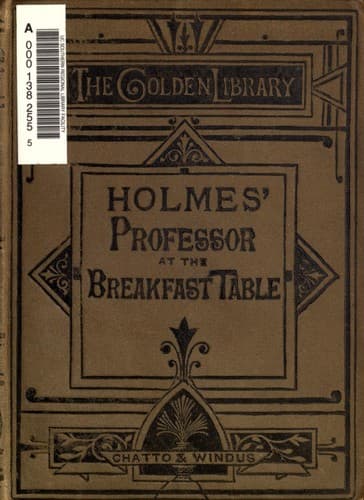
The Professor at the Breakfast-TableHolmes, Oliver Wendell
General
The Professor at the Breakfast-Table
Holmes, Oliver Wendell
American fiction -- 19th century; Conversation -- Fiction; Poetry
that every good and, alas! every evil act we do may slumber unforgotten
even in some earthly record. I got a new lesson in that humanity which
our sharp race finds it so hard to learn. The poor widow, fighting
hard to feed and clothe and educate her children, had not forgotten the
poorer ancient maidens. I remembered it the other day, as I stood by her
place of rest, and I felt sure that it was remembered elsewhere. I know
there are prettier words than pudding, but I can't help it,--the pudding
went upon the record, I feel sure, with the mite which was cast into the
treasury by that other poor widow whose deed the world shall remember
forever, and with the coats and garments which the good women cried
over, when Tabitha, called by interpretation Dorcas, lay dead in the
upper chamber, with her charitable needlework strewed around her.
--Such was the Book of the Maiden Sisters. You will believe me more
readily now when I tell you that I found the soul of Iris in the one
that lay open before me. Sometimes it was a poem that held it, sometimes
a drawing, angel, arabesque, caricature, or a mere hieroglyphic
symbol of which I could make nothing. A rag of cloud on one page, as I
remember, with a streak of red zigzagging out of it across the paper as
naturally as a crack runs through a China bowl. On the next page a dead
bird,--some little favorite, I suppose; for it was worked out with a
special love, and I saw on the leaf that sign with which once or twice
in my life I have had a letter sealed,--a round spot where the paper
is slightly corrugated, and, if there is writing there, the letters
are somewhat faint and blurred. Most of the pages were surrounded with
emblematic traceries. It was strange to me at first to see how often
she introduced those homelier wild-flowers which we call weeds,--for it
seemed there was none of them too humble for her to love, and none too
little cared for by Nature to be without its beauty for her artist
eye and pencil. By the side of the garden-flowers,--of Spring's curled
darlings, the hyacinths, of rosebuds, dear to sketching maidens, of
flower-de-luces and morning-glories, nay, oftener than these, and more
tenderly caressed by the colored brush that rendered them,--were those
common growths which fling themselves to be crushed under our feet and
our wheels, making themselves so cheap in this perpetual martyrdom that
we forget each of them is a ray of the Divine beauty.
Public-domain text, read in full here on John Shaqi.
Reviews
Reviews
No reviews yet
Be the first to share your thoughts on this work.
Elsewhere in the archive
Join the Discussion
Join the discussion
Sign in to leave a comment or review.
Sign InorCreate an account