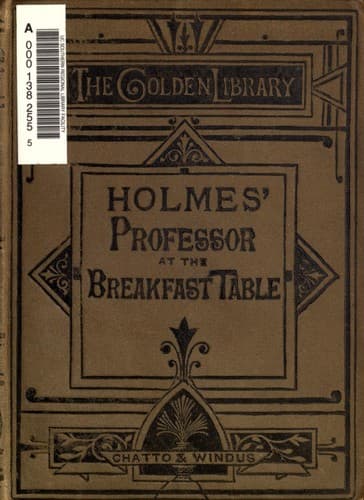
The Professor at the Breakfast-TableHolmes, Oliver Wendell
General
The Professor at the Breakfast-Table
Holmes, Oliver Wendell
American fiction -- 19th century; Conversation -- Fiction; Poetry
Then a good many of our race are very hard and unimaginative;--their
voices have nothing caressing; their movements are as of machinery
without elasticity or oil. I wish it were fair to print a letter a young
girl, about the age of our Iris, wrote a short time since. “I am *** ***
***,” she says, and tells her whole name outright. Ah!--said I, when I
read that first frank declaration,--you are one of the right sort!--She
was. A winged creature among close-clipped barn door fowl. How tired
the poor girl was of the dull life about her,--the old woman's “skeleton
hand” at the window opposite, drawing her curtains,--“Ma'am shooing away
the hens,”--the vacuous country eyes staring at her as only country
eyes can stare,--a routine of mechanical duties, and the soul's
half-articulated cry for sympathy, without an answer! Yes,--pray for
her, and for all such! Faith often cures their longings; but it is so
hard to give a soul to heaven that has not first been trained in the
fullest and sweetest human affections! Too often they fling their hearts
away on unworthy objects. Too often they pine in a secret discontent,
which spreads its leaden cloud over the morning of their youth. The
immeasurable distance between one of these delicate natures and the
average youths among whom is like to be her only choice makes one's
heart ache. How many women are born too finely organized in sense and
soul for the highway they must walk with feet unshod! Life is adjusted
to the wants of the stronger sex. There are plenty of torrents to be
crossed in its journey; but their stepping-stones are measured by the
stride of man, and not of woman.
Women are more subject than men to atrophy of the heart. So says the
great medical authority, Laennec. Incurable cases of this kind used
to find their hospitals in convents. We have the disease in New
England,--but not the hospitals. I don't like to think of it. I will not
believe our young Iris is going to die out in this way. Providence will
find her some great happiness, or affliction, or duty,--and which would
be best for her, I cannot tell. One thing is sure: the interest she
takes in her little neighbor is getting to be more engrossing than ever.
Something is the matter with him, and she knows it, and I think worries
herself about it.
I wonder sometimes how so fragile and distorted a frame has kept the
fiery spirit that inhabits it so long its tenant. He accounts for it in
his own way.
Public-domain text, read in full here on John Shaqi.
Reviews
Reviews
No reviews yet
Be the first to share your thoughts on this work.
Elsewhere in the archive
Join the Discussion
Join the discussion
Sign in to leave a comment or review.
Sign InorCreate an account