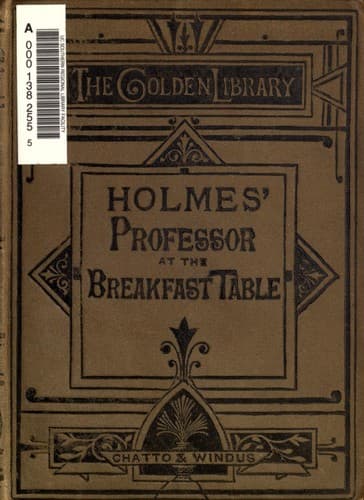
The Professor at the Breakfast-TableHolmes, Oliver Wendell
General
The Professor at the Breakfast-Table
Holmes, Oliver Wendell
American fiction -- 19th century; Conversation -- Fiction; Poetry
Do you know that every man has a religious belief peculiar to himself?
Smith is always a Smithite. He takes in exactly Smith's-worth of
knowledge, Smith's-worth of truth, of beauty, of divinity. And Brown has
from time immemorial been trying to burn him, to excommunicate him,
to anonymous-article him, because he did not take in Brown's-worth of
knowledge, truth, beauty, divinity. He cannot do it, any more than a
pint-pot can hold a quart, or a quart-pot be filled by a pint. Iron is
essentially the same everywhere and always; but the sulphate of iron is
never the same as the carbonate of iron. Truth is invariable; but the
Smithate of truth must always differ from the Brownate of truth.
The wider the intellect, the larger and simpler the expressions in which
its knowledge is embodied. The inferior race, the degraded and enslaved
people, the small-minded individual, live in the details which to larger
minds and more advanced tribes of men reduce themselves to axioms and
laws. As races and individual minds must always differ just as sulphates
and carbonates do, I cannot see ground for expecting the Broad Church
to be founded on any fusion of intellectual beliefs, which of course
implies that those who hold the larger number of doctrines as essential
shall come down to those who hold the smaller number. These doctrines
are to the negative aristocracy what the quarterings of their coats are
to the positive orders of nobility.
The Broad Church, I think, will never be based on anything that requires
the use of language. Freemasonry gives an idea of such a church, and a
brother is known and cared for in a strange land where no word of
his can be understood. The apostle of this church may be a deaf mute
carrying a cup of cold water to a thirsting fellow-creature. The cup
of cold water does not require to be translated for a foreigner to
understand it. I am afraid the only Broad Church possible is one that
has its creed in the heart, and not in the head,--that we shall know
its members by their fruits, and not by their words. If you say this
communion of well-doers is no church, I can only answer, that all
organized bodies have their limits of size, and that when we find a man
a hundred feet high and thirty feet broad across the shoulders, we will
look out for an organization that shall include all Christendom.
Some of us do practically recognize a Broad Church and a Narrow Church,
however. The Narrow Church may be seen in the ship's boats of humanity,
in the long boat, in the jolly boat, in the captain's gig, lying off the
poor old vessel, thanking God that they are safe, and reckoning how soon
the hulk containing the mass of their fellow-creatures will go down. The
Broad Church is on board, working hard at the pumps, and very slow to
believe that the ship will be swallowed up with so many poor people in
it, fastened down under the hatches ever since it floated.
Public-domain text, read in full here on John Shaqi.
Reviews
Reviews
No reviews yet
Be the first to share your thoughts on this work.
Elsewhere in the archive
Join the Discussion
Join the discussion
Sign in to leave a comment or review.
Sign InorCreate an account