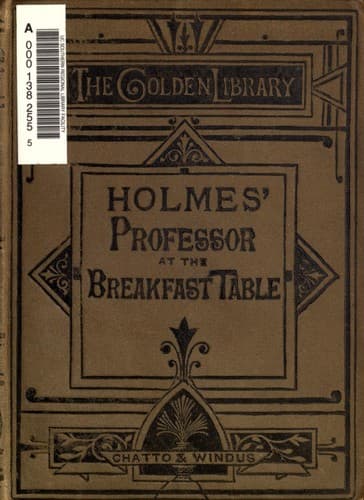
The Professor at the Breakfast-TableHolmes, Oliver Wendell
General
The Professor at the Breakfast-Table
Holmes, Oliver Wendell
American fiction -- 19th century; Conversation -- Fiction; Poetry
I wish I were half as good as many heathens have been,--I said.--Dying
for a principle seems to me a higher degree of virtue than scolding for
it; and the history of heathen races is full of instances where men have
laid down their lives for the love of their kind, of their country, of
truth, nay, even for simple manhood's sake, or to show their obedience
or fidelity. What would not such beings have done for the souls of men,
for the Christian commonwealth, for the King of Kings, if they had lived
in days of larger light? Which seems to you nearest heaven, Socrates
drinking his hemlock, Regulus going back to the enemy's camp, or that
old New England divine sitting comfortably in his study and chuckling
over his conceit of certain poor women, who had been burned to death in
his own town, going “roaring out of one fire into another”?
I don't believe he said any such thing,--replied the Poor Relation.
It is hard to believe,--said I,--but it is true for all that. In another
hundred years it will be as incredible that men talked as we sometimes
hear them now.
Pectus est quod facit theologum. The heart makes the theologian. Every
race, every civilization, either has a new revelation of its own or a
new interpretation of an old one. Democratic America, has a different
humanity from feudal Europe, and so must have a new divinity. See,
for one moment, how intelligence reacts on our faiths. The Bible was a
divining-book to our ancestors, and is so still in the hands of some of
the vulgar. The Puritans went to the Old Testament for their laws; the
Mormons go to it for their patriarchal institution. Every generation
dissolves something new and precipitates something once held in solution
from that great storehouse of temporary and permanent truths.
You may observe this: that the conversation of intelligent men of the
stricter sects is strangely in advance of the formula that belong to
their organizations. So true is this, that I have doubts whether a large
proportion of them would not have been rather pleased than offended,
if they could have overheard our talk. For, look you, I think there is
hardly a professional teacher who will not in private conversation allow
a large part of what we have said, though it may frighten him in print;
and I know well what an under-current of secret sympathy gives vitality
to those poor words of mine which sometimes get a hearing.
Public-domain text, read in full here on John Shaqi.
Reviews
Reviews
No reviews yet
Be the first to share your thoughts on this work.
Elsewhere in the archive
Join the Discussion
Join the discussion
Sign in to leave a comment or review.
Sign InorCreate an account