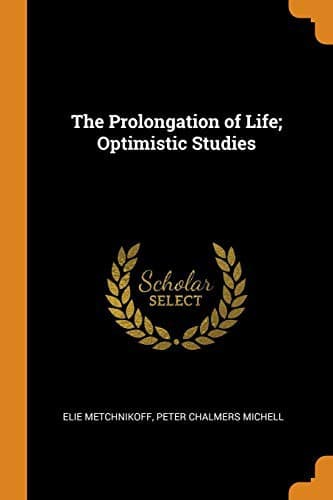
The Prolongation of Life: Optimistic StudiesMetchnikoff, Elie
Science
The Prolongation of Life: Optimistic Studies
Metchnikoff, Elie
Aging; Hygiene; Longevity; Older people -- Social conditions
If it be true that our precocious and unhappy old age is due to
poisoning of the tissues (the greater part of the poison coming from
the large intestine inhabited by numberless microbes), it is clear
that agents which arrest intestinal putrefaction must at the same time
postpone and ameliorate old age. This theoretical view is confirmed by
the collection of facts regarding races which live chiefly on soured
milk, and amongst which great ages are common. However, in a question
so important, the theory must be tested by direct observations. For
this purpose the numerous infirmaries for old people should be taken
advantage of, and systematic investigations should be made on the
relation of intestinal microbes to precocious old age, and on the
influence of diets which prevent intestinal putrefaction in prolonging
life and maintaining the forces of the body. It can only be in the
future, near or remote, that we shall obtain exact information upon
what is one of the chief problems of humanity.
In the meantime, those who wish to preserve their intelligence as
long as possible and to make their cycle of life as complete and as
normal as is possible under present conditions, must depend on general
sobriety and on habits conforming to the rules of rational hygiene.
PART V
PSYCHICAL RUDIMENTS IN MAN
I
RUDIMENTARY ORGANS IN MAN
Reply to critics who deny the simian origin of
man—Actual existence of rudimentary organs—Reductions
in the structure of the organs of sense in man—Atrophy
of Jacobson’s organ and of the Harderian gland in the
human race
Several critics of _The Nature of Man_ have protested against my
theory of the simian origin of man. Some of these found my arguments
unsatisfactory and unconvincing. Others have attacked generally my
suggestion that some anthropoid had been suddenly transformed to a
primitive human being.
It is true that so long as we have little palæontological evidence as
to the actual descent of man, we cannot discuss the subject without
the aid of hypotheses. I think, however, that recent additions to
knowledge confirm the theory of the descent of man in a way that ought
to influence the most resolute opponents. I have in mind chiefly
the arguments supplied by the embryology of anthropoid apes, and by
the investigation of their blood. None the less, there are still
many authors who maintain their opposition. One of my critics, Dr.
Jousset,[150] enumerates certain differences in the structure of the
skeleton in man and apes, and concludes that these radically separate
man from apes.
Public-domain text, read in full here on John Shaqi.
Reviews
Reviews
No reviews yet
Be the first to share your thoughts on this work.
Elsewhere in the archive
Join the Discussion
Join the discussion
Sign in to leave a comment or review.
Sign InorCreate an account