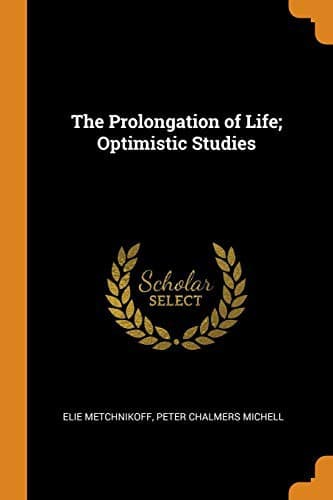
The Prolongation of Life: Optimistic StudiesMetchnikoff, Elie
Science
The Prolongation of Life: Optimistic Studies
Metchnikoff, Elie
Aging; Hygiene; Longevity; Older people -- Social conditions
“A sacred enthusiasm inspires me on this classic soil; the old world
and the world around me raise their voices and draw me to them.
Here I follow the ideas and turn over the pages of the ancient
writers, giving myself no rest whilst day lasts and ever reaching new
delights. By night love calls me to other cares; and if I am only half
a philosopher, I am twice happy. But may I not say that I am also
learning when my eye follows the contours of a loving breast, when with
my hand I trace the lines of her form? It is then that I understand
marble, I think and compare, I see with an eye that touches and touch
with a hand that sees.” “Often I have made verses in her arms; often
my playful finger has softly beaten out my hexameters on her back. As
she breathes in her sweet sleep, her breath burns me to my innermost
soul.”[193]
His stay in Italy brought Goethe definitely to maturity. On this
important stage in his life let us hear his biographer, Bielschowsky.
“The voyage to Italy made a new man of him. His sickliness and
nervousness disappeared. The melancholy which led him to think of early
death and made him regard death as better than the former conditions
of his life was replaced by a sublime serenity and joy in living. The
taciturn and preoccupied man who in no society abandoned his grave
thoughts had become happy as a child” (vol. i, p. 412). “From this
time on, in calm and enviable security, he passed through the cycle of
life which seemed so mysterious to others. Goethe became the serene
Olympian, the wonder of posterity, whilst many of his contemporaries no
longer saw in him the passionate pilgrim” (_ibid._, p. 417).
It was after reaching the age of forty years that Goethe entered on the
optimistic phase of his life.
II
GOETHE AND OPTIMISM
Goethe’s optimistic period—His mode of life
in that period—Influence of love in artistic
production—Inclinations towards the arts must be
regarded as secondary sexual characters—Senile love of
Goethe—Relation between genius and the sexual activities
The moral equilibrium of the great writer was not established once
for all. In the course of his life, Goethe had several relapses into
pessimism which, however, were ephemeral, and after which he became a
man as complete and harmonious as was possible in the circumstances of
his life. He reached a serene old age, and his activity did not relax
until after his eightieth year, when he died.
Public-domain text, read in full here on John Shaqi.
Reviews
Reviews
No reviews yet
Be the first to share your thoughts on this work.
Elsewhere in the archive
Join the Discussion
Join the discussion
Sign in to leave a comment or review.
Sign InorCreate an account