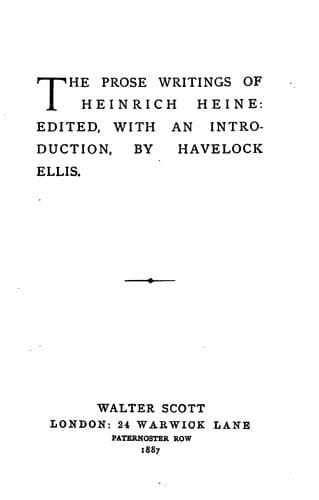
The Prose Writings of Heinrich HeineHeine, Heinrich
General
The Prose Writings of Heinrich Heine
Heine, Heinrich
Heine, Heinrich, 1797-1856 -- Translations into English
And yet neither in the masterpieces of other artists, nor in nature
herself, do we find these two types in their varying relations so
minutely elaborated as in Cervantes. Every trait in the character and
appearance of the one answers to a contrasting, and yet kindred, trait
in the other. Here every detail has a burlesque signification; yes, even
between Rosinante and Sancho's grey donkey there exists the same ironic
parallelism as between the squire and the knight, and the two beasts are
made to convey symbolically the same idea. As in their modes of thought,
so also in their speech, do master and servant reveal a most marvellous
contrast, and I cannot here omit to refer to the difficulties with which
the translator has had to contend in order to reproduce in German the
homely, gnarled dialect of our good Sancho. Through his blunt,
frequently vulgar speeches, and his fondness for proverbialising, our
good Sancho reminds us of King Solomon's fool, and of Marculfe, who,
also, in opposition to a somewhat pathetic idealism, expresses in short
and pithy sayings the practical wisdom of the common people. Don
Quixote, on the contrary, speaks the language of culture, of the higher
classes, and in the solemn gravity of his well-rounded periods, he
fairly represents the high-born Hidalgo. At times his sentences are spun
out too broadly, and the knight's language resembles a haughty court
dame, attired in a much bepuffed silken robe, with a long rustling
train. But the graces, disguised as pages, laughingly carry the tips of
this train, and the long sentences end with the most charming turns.
The character of Don Quixote's language and that of Sancho Panza may be
briefly summarised in the words: the former, when he speaks, seems
always mounted on his high horse; the latter, as if seated on his humble
donkey.
It is remarkable that a book which is so rich as _Don_ Quixote in
picturesque matter has as yet found no painter who has taken from it
subjects for a series of independent art works. Is the spirit of the
book so volatile and fanciful that the variegated colours elude the
artist's skill? I do not think so, for _Don Quixote_, light and fanciful
as it is, is still based on rude, earthly realities, as must necessarily
be the case to make it a book of the people. Is it, perhaps, because
behind the figures brought before us by the poet, deeper ideas lie
hidden, which the artist cannot produce again, so that he can give only
the outward features, salient though they be, but fails to grasp and
reproduce the deeper meaning?
GODS IN EXILE.
Public-domain text, read in full here on John Shaqi.
Reviews
Reviews
No reviews yet
Be the first to share your thoughts on this work.
Elsewhere in the archive
Join the Discussion
Join the discussion
Sign in to leave a comment or review.
Sign InorCreate an account