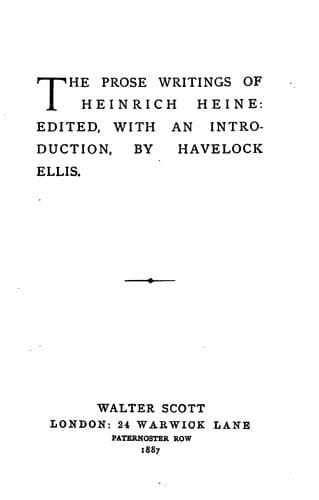
The Prose Writings of Heinrich HeineHeine, Heinrich
General
The Prose Writings of Heinrich Heine
Heine, Heinrich
Heine, Heinrich, 1797-1856 -- Translations into English
Alas! what then sounded so strange is now being preached from all the
house-tops in Germany, and the fanatic zeal of many of these
propagandists is terrible! We have now bigoted monks of atheism,
grand-inquisitors of infidelity, who would have bound Voltaire to the
stake because he was at heart an obstinate deist. So long as such
doctrines remained the secret possession of an intellectual aristocracy,
and were discussed in a select coterie-dialect which was
incomprehensible to the lackeys in attendance, while we at our
philosophical _petit-soupers_ were blaspheming, so long did I continue
to be one of the thoughtless free-thinkers, of whom the majority
resembled those grand-seigneurs who, shortly before the Revolution,
sought by means of the new revolutionary ideas to dispel the tedium of
their indolent court-life. But as soon as I saw that the rabble began to
discuss the same themes at their unclean symposiums, where instead of
wax-candles and chandeliers gleamed tallow-dips and oil-lamps; when I
perceived that greasy cobblers and tailors presumed in their blunt
mechanics' speech to deny the existence of God; when atheism began to
stink of cheese, brandy, and tobacco--then my eyes were suddenly opened,
and that which I had not comprehended through reason, I now learned
through my olfactory organs and through my loathing and disgust. Heaven
be praised! my atheism was at an end.
To be candid, it was perhaps not alone disgust that made the principles
of the godless obnoxious to me, and induced me to abandon their ranks. I
was oppressed by a certain worldly apprehension which I could not
overcome, for I saw that atheism had entered into a more or less secret
compact with the most terribly naked, quite fig-leafless, communistic
communism. My dread of the latter has nothing in common with that of the
parvenu, who trembles for his wealth, or with that of well-to-do
tradesmen, who fear an interruption of their profitable business. No;
that which disquiets me is the secret dread of the artist and scholar,
who sees our whole modern civilisation, the laboriously-achieved product
of so many centuries of effort, and the fruit of the noblest works of
our ancestors, jeopardised by the triumph of communism. Swept along by
the resistless current of generous emotions, we may perhaps sacrifice
the cause of art and science, even all our own individual interests, for
the general welfare of the suffering and oppressed people. But we can no
longer disguise from ourselves what we have to expect when the great,
rude masses, which by some are called the people, by others the rabble,
and whose legitimate sovereignty was proclaimed long ago, shall obtain
actual dominion. The poet, in particular, experiences a mysterious
dread in contemplating the advent to power of this uncouth sovereign. We
will gladly sacrifice ourselves for the people, for self-sacrifice
constitutes one of our most exquisite enjoyments--the emancipation of
Public-domain text, read in full here on John Shaqi.
Reviews
Reviews
No reviews yet
Be the first to share your thoughts on this work.
Elsewhere in the archive
Join the Discussion
Join the discussion
Sign in to leave a comment or review.
Sign InorCreate an account