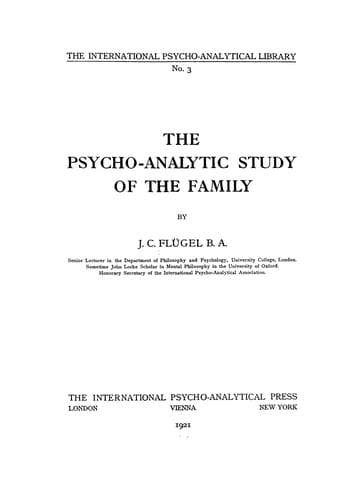
The psycho-analytic study of the familyFlugel, J. C. (John Carl)
Science
The psycho-analytic study of the family
Flugel, J. C. (John Carl)
Families; Marriage; Parent and child; Psychoanalysis
Small wonder then that the adult human being, confronted with the mighty
forces of nature, the laws of which he is compelled to follow, if he
would avoid destruction, but which--especially if he be ignorant or
uncivilised--he cannot comprehend, tends to revert to the attitude of mind
in which, in childhood, he looked upon his parents as the forces--equally
powerful, as they then seemed, and equally inscrutable--that controlled
his fate. In proportion as the child, with increasing age and experience,
loses the delusions he had entertained as regards the all-powerfulness,
all-knowingness and all-goodness of his parents, he begins to realise,
both from his own experience and from instruction and tradition, that
there are powers in the Universe which exceed the greatest human might,
powers before whom the child's own parents--together with all other
mortals--must acknowledge their own humility and impotence, powers so vast
that it may seem only reasonable and befitting to regard the wielder of
them as the possessor of those qualities of omnipotence and omniscience
that were once, in the crude ignorance of infancy, vaguely attributed
to the parents and to other adult persons of importance. The divine and
superhuman forces, about which the child thus begins to have some notions,
constitute in this way a very natural substitute for the exaggerated and
idealised estimation of the parents which the child's increasing knowledge
of human life compels him to abandon, but which he nevertheless, as we
have seen (_cp._ above p. 55), gives up reluctantly.
[Sidenote: The divine and the human parent]
The displacement of the parent-regarding emotions and tendencies in this
direction is, in the case of the individual, often further facilitated in
the three following ways:--(1) owing to the generally pronounced animistic
tendency of the primitive mind, the child naturally and indeed inevitably
conceives of natural forces in a personal and usually in a human form;
(2) the child early learns to conceive of the supreme forces of the
Universe as creative--creative on a large scale, just as his own parents
and other human beings are creative on a small scale; further he learns
that he owes his own creation to God as much as to his own parents--to God
ultimately, to his parents proximately; (3) in both these respects the
individual tendency to endow the Divinity with attributes derived from the
parents is greatly stimulated and reinforced by the suggestive power of
religious tradition, working through the channels of direct teaching or of
representation in language, literature and art.
[Sidenote: Remoter ancestors as divine parent substitutes]
Public-domain text, read in full here on John Shaqi.
Reviews
Reviews
No reviews yet
Be the first to share your thoughts on this work.
Elsewhere in the archive
Join the Discussion
Join the discussion
Sign in to leave a comment or review.
Sign InorCreate an account