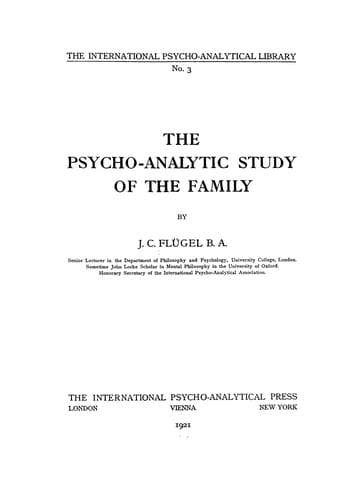
The psycho-analytic study of the familyFlugel, J. C. (John Carl)
Science
The psycho-analytic study of the family
Flugel, J. C. (John Carl)
Families; Marriage; Parent and child; Psychoanalysis
[Footnote 181: _Cp._ Frazer. "The Dying God," 5. Gibbon, "Decline and Fall
of the Roman Empire," 1858, Vol. VI. Ch. L, 223. The notion of the Holy
Ghost as a mother is also found to occur spontaneously in children. _Cp._
Sully, "Studies of Childhood," 132.]
[Footnote 182: The repression of the mother-regarding feelings has had its
influence not only on the attitude towards the mother element in religion
and on the attitude towards women in general, but also on everything that
is (consciously or unconsciously) associated with women and especially
with the mother. There is one curious instance of this influence which
has been of very considerable importance in the history of philosophy,
science and of man's attitude towards some of the most important problems
of life and mind. There exists a very general association, on the one hand
between the notion of mind, spirit or soul and the idea of the father or
of masculinity; and on the other hand between the notion of the body or
of matter (_materia_ = that which belongs to the mother) and the idea of
the mother or of the feminine principle. The repression of the emotions
and feelings relating to the mother has, in virtue of this association,
produced a tendency to adopt an attitude of distrust, contempt, disgust
or hostility towards the human body, the Earth, and the whole material
Universe, with a corresponding tendency to exalt and over-emphasise the
spiritual elements, whether in man or in the general scheme of things. It
seems very probable that a good many of the more pronouncedly idealistic
tendencies in philosophy may owe much of their attractiveness in many
minds to a sublimation of this reaction against the mother, while the
more dogmatic and narrow forms of materialism may perhaps in their turn
represent a return of the repressed feelings originally connected with the
mother. (_Cp._ Von Winterstein, _op. cit._)]
[Footnote 183: See E. S. Hartland, "Primitive Paternity," Vol. I. Ch. I.]
[Footnote 184: It is suggestive to note that, in order to make sure that
Mary had no connection with men whatsoever, it was decided (Papal Bull
1853) that she did not even have a father.]
[Footnote 185: _Cp._ Lorenz, "Das Titanenmotiv in der allgemeinen
Mythologie," _Imago_, II.]
[Footnote 186: The very general identification of the Earth with the
mother has probably played an important part in the history of human
culture inasmuch as it has afforded a ready means of rendering psychic
energy available for the practice of agriculture; the cultivation of the
Earth's surface being from the psychological point of view a displacement
of the original incestuous desires directed to the mother. On the other
hand the very closeness of the association between mother and Earth has in
some places led to a reluctance to till the soil, such an act being looked
upon as impious (See Frazer, "Adonis, Attis, Osiris," I. 80 ff.).]
Public-domain text, read in full here on John Shaqi.
Reviews
Reviews
No reviews yet
Be the first to share your thoughts on this work.
Elsewhere in the archive
Join the Discussion
Join the discussion
Sign in to leave a comment or review.
Sign InorCreate an account