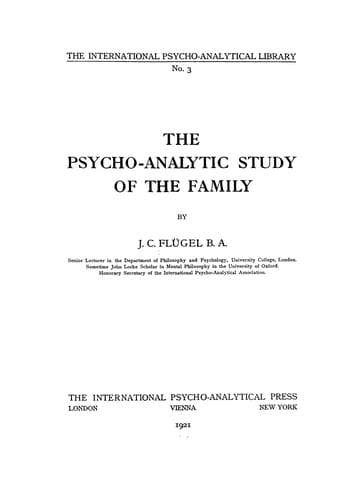
The psycho-analytic study of the familyFlugel, J. C. (John Carl)
Science
The psycho-analytic study of the family
Flugel, J. C. (John Carl)
Families; Marriage; Parent and child; Psychoanalysis
Thus we have seen that the direction of the child's affection to the
parent of the opposite sex rather than to the one of his own sex is
probably determined largely by the extent of the affection which the child
in his turn receives from the two parents respectively; the heterosexual
inclinations of the parents causing them on the whole, and in the absence
of any powerful factors tending to produce an opposite result, to give
their love most freely towards those of their children who are of the
opposite sex to their own. We have seen too that the nature and duration
of the feelings of envy, jealousy and hate which a child is liable to
experience towards one or other of its parents are to a very considerable
extent dependent on the behaviour of this parent towards the child. It is
evident also from our previous considerations that there is likely to be
a quantitative as well as a qualitative correspondence between the love
and hate which a child may feel towards its parents and the manifestation
of corresponding emotions in the parents themselves. All that is left for
us to do in this direction is to look a little more closely into some
of the factors which determine the nature and extent of the affective
reactions of the parent towards the child.
[Sidenote: The instinctive love of parents to children]
[Sidenote: The love of parents to children stands in reciprocal
relationship to the parents' other interests and affections]
It is now pretty generally agreed among psychologists that the love of
parents to their children takes place in virtue of the formation of a
sentiment[200] or organisation of instinctive dispositions about an
idea (in this case the idea of the child), and it is further usually
supposed that in this sentiment a leading part is played by a particular
instinctive disposition--a disposition which manifests itself in
consciousness in an emotion of more or less specific quality, to which
McDougall, following Ribot, has given the now familiar term "tender
emotion." Now there are clear indications that the energy involved in this
disposition (like that of all other instinctive dispositions) can play a
part--and normally does play a part--in many other sentiments besides that
which is concerned in the love of a parent towards his (or her) child.
For this reason the emotional outflow along the lines of this latter
sentiment varies to some extent in inverse proportion to the outflow along
the lines of other sentiments. Thus the amount of love which a parent
can bestow upon a child is limited by the amount of the affection and
interest which he bestows upon other persons and other things. The parent
who has no other occupation in life than the care of his or her children
is usually bound to these children by emotional ties of a much closer,
more intimate and more intensive nature than is one whose energies are
partially absorbed by outside interests and occupations. The parent of
Public-domain text, read in full here on John Shaqi.
Reviews
Reviews
No reviews yet
Be the first to share your thoughts on this work.
Elsewhere in the archive
Join the Discussion
Join the discussion
Sign in to leave a comment or review.
Sign InorCreate an account