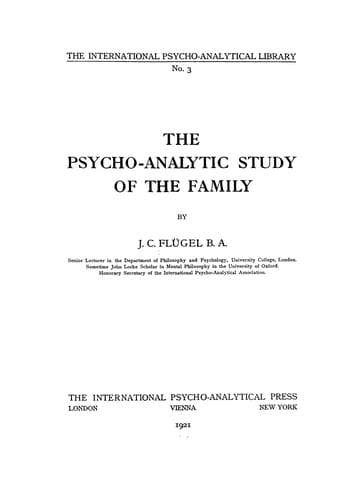
The psycho-analytic study of the familyFlugel, J. C. (John Carl)
Science
The psycho-analytic study of the family
Flugel, J. C. (John Carl)
Families; Marriage; Parent and child; Psychoanalysis
The interference of children with the activities and desires of the father
is usually less direct and the ill-will which fathers bear towards their
children is therefore more apt to be aroused in consequence of jealousy
than is the corresponding feeling of the mother. Nevertheless, in the case
of the father too, there almost always sooner or later arises some degree
of interference with his pleasure, his comfort, his work or his ambitions;
so that he feels that his children constitute a burden which seriously
hampers his individual progress or enjoyment.
[Sidenote: Identification of the child with its grandparent]
The hostile feelings of parents towards their children which take their
origin from one or more of these sources are often powerfully stimulated
and reinforced by an unconscious process in virtue of which the child
is identified with the parent's own parent (the child's grandparent).
This tendency to identify child with grandparent is one which would seem
to be deeply implanted in the human mind[204]. Thus in several parts of
the world grandparents are supposed to become re-incarnated in their
grandchildren--a belief which is probably responsible for the widespread
practice (observed among others by the ancient Greeks) of naming a
child after its grandparent, especially in the case of eldest sons who
frequently receive the name of their paternal grandfather[205].
[Sidenote: Causes of this similarity of parent-child to previous
child-parent relationship]
For the grounds of this belief and the tendencies which have given rise
to it, it is probable that we must look to the similarities between the
relations of parent to child and those which had existed a generation
earlier between child and parent. As we have just seen, the feelings that
are liable to be evoked by these relationships are in certain respects
not dissimilar, and it would appear as though the situation in which
an individual is placed when he becomes a parent serves to call up in
him some of the partially forgotten and partially outgrown emotions and
tendencies which he had experienced in his own childhood and to direct
them now upon his child in the same way as he had formerly directed them
upon his parent. Thus the new position in which a father finds himself
in competition with his son for the affection of his wife revives in
the Unconscious a memory of the former situation in which as a child he
competed with his father for the love of his mother.
[Sidenote: The "phantasy of the reversal of generations"]
Public-domain text, read in full here on John Shaqi.
Reviews
Reviews
No reviews yet
Be the first to share your thoughts on this work.
Elsewhere in the archive
Join the Discussion
Join the discussion
Sign in to leave a comment or review.
Sign InorCreate an account