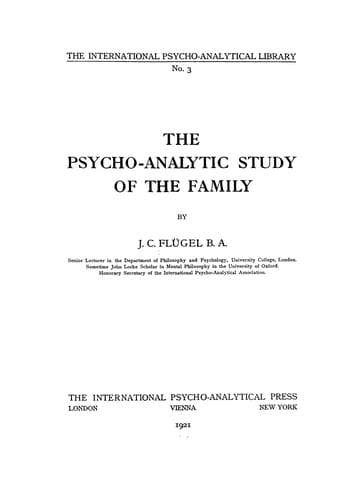
The psycho-analytic study of the familyFlugel, J. C. (John Carl)
Science
The psycho-analytic study of the family
Flugel, J. C. (John Carl)
Families; Marriage; Parent and child; Psychoanalysis
It might well seem indeed as though some degree of ill-feeling on these
grounds would be inevitable in all parents in whom the self-regarding
sentiments were strongly or even normally developed. Fortunately
however it would appear that there exists a way by which the hatred
and unhappiness arising from this source can to a very large extent be
converted into feelings of an opposite and socially more satisfactory
character. It is here that there comes into play the second of the two
factors mentioned above. This factor consists of the process whereby
the parent identifies himself with his child, as it were incorporates
the child into his larger self and is thus able to take pleasure in the
increasing powers of the child as if they were his own. We have already
had occasion to study the corresponding process of identification in the
mind of the child; the child tends naturally to identify himself with his
parents or their substitutes, seeking thereby an increase of his own power
and satisfaction. For precisely similar reasons the parent, as old age
approaches (and even before then), will tend to identify himself with his
child, endeavouring thus to find compensation for the diminution of his
own personal capacity. Thus a father may regard the successes and failures
of his son in his scholastic and professional career with the same
personal interest, the same intimate emotional response as if they were
his own, while the mother often follows her daughters' erotic ambitions
and adventures, her matrimonial and parental life with a similar intensity
of feeling.
[Sidenote: This identification as a means of obtaining immortality]
This identification plays moreover a further and perhaps still more
important part inasmuch as it affords a means of overcoming the finality
of individual death, and insures the parent, through his children and
ultimately through their descendants, the nearest approach to material
immortality that can be hoped for here on earth. The love of children
and interest in their welfare which springs from the altruistic and
object-loving tendencies involved in the parental instincts may thus
become fused with the strongly egoistic tendencies grouped together under
the self-preserving and self-regarding instincts and sentiments; that
dearest and most powerful wish of the individual, _qua_ individual--the
desire for immortality--thus obtaining satisfaction in the same way and
at the same time as the strongest and most distinctive of all altruistic
impulses--those which minister to the needs of the race through the
love and care which is bestowed upon children by their parents. A
reconciliation of the egoistic and the altruistic, of the personal and the
racial trends, is thus brought about--a reconciliation which may be of the
greatest value to the individual, to the family and to the larger social
organism of which they both form a part.
[Sidenote: Vicarious enjoyments of children's pleasures and successes]
Public-domain text, read in full here on John Shaqi.
Reviews
Reviews
No reviews yet
Be the first to share your thoughts on this work.
Elsewhere in the archive
Join the Discussion
Join the discussion
Sign in to leave a comment or review.
Sign InorCreate an account