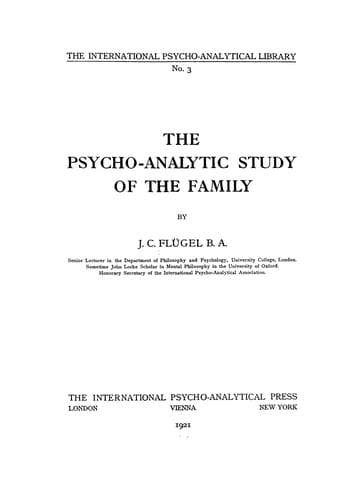
The psycho-analytic study of the familyFlugel, J. C. (John Carl)
Science
The psycho-analytic study of the family
Flugel, J. C. (John Carl)
Families; Marriage; Parent and child; Psychoanalysis
Since these groups of impulses have shown themselves to play a part of
such importance in human mind and human conduct, it is not unnatural
that, having completed our review of their manifestations, we should feel
some curiosity as to the manner in which they have come to play this part
in the course of the past history of the human race and as to the nature
of the influence which they have exerted on this history. Unfortunately
in the present state of our knowledge it would not seem possible to
gratify this curiosity except in a very partial, unsatisfactory and
uncertain manner. The psychological mechanisms with which we have been
dealing have themselves, for the most part, been too recently discovered
to have as yet been adequately correlated, or brought into connection,
with the relevant facts of anthropological, ethnographical or biological
science. The data from these latter sources are moreover, in spite of
much diligent research in recent years, still in many important respects
too incomplete to afford a satisfactory basis for such correlation. As
a consequence of these conditions, it is to be feared that any attempt
that we may make to exhibit the psychical tendencies with which we have
been concerned, in their bearings upon early human history, or to explain
their origin in the light of this history or of the general conditions
of human life and mind, will result in little more than a restatement of
our psychological principles from a slightly different point of view.
Nevertheless the attempt may be worth making. A summary of some of the
main implications of our psychological knowledge in this field may perhaps
not seem amiss--especially in view of the astonishing and unlooked-for
character of much of this knowledge--and if we succeed in establishing a
few connections between our psychological data and the related facts of
anthropology or biology, these may perhaps serve as starting points--to
be either proved or else corrected--for subsequent enquiries based on a
more sound foundation. The reader will understand therefore that, in so
far as in the present and the two succeeding chapters there is anything
that is not--explicitly or implicitly--contained in what we have already
said, we shall have left the region of comparative certainty afforded
by the results of observation and induction, and shall be travelling
for the most part on the unsure ground of speculation--speculation that
can be justified only on the plea of natural curiosity, and by the hope
of opening up a few vistas which may be more fully surveyed by better
equipped workers in the future.
[Sidenote: The hate tendencies to some extent inevitable]
Public-domain text, read in full here on John Shaqi.
Reviews
Reviews
No reviews yet
Be the first to share your thoughts on this work.
Elsewhere in the archive
Join the Discussion
Join the discussion
Sign in to leave a comment or review.
Sign InorCreate an account