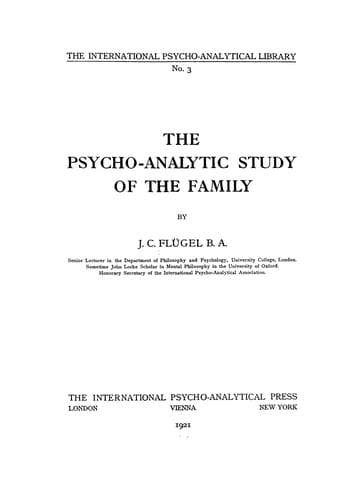
The psycho-analytic study of the familyFlugel, J. C. (John Carl)
Science
The psycho-analytic study of the family
Flugel, J. C. (John Carl)
Families; Marriage; Parent and child; Psychoanalysis
In those societies which have developed or maintained a relatively strict
monogamy we should expect that this kind of parent hatred would be more
easily and extensively developed than in those in which the marriage tie
is looser, wider or more elastic, since in the former case the hatred
bred of jealousy would necessarily be directed on to a single individual,
whereas in the latter it might lose in intensity through diffusion over a
number of different persons. Now it is a feature of that relatively early
stage of culture which with Wundt[217] we may perhaps call the Totemic
age that the family ties are as a rule relaxed in favour of those wider
bonds that unite together the different members of the tribe or clan. In
this age we often find that some form of group marriage exists or shows
evident traces of having existed; in distinction to the more or less
strictly monogamous unions that are characteristic both of those races of
mankind which are at a more primitive level of development and of those
that have reached a more advanced stage of culture. We might imagine
therefore that this Totemic age was distinguished by a lessening of the
parent jealousy which must probably have existed both in the earlier
and in the later societies of a more strictly monogamic kind. We have
seen indeed that a reconciliation between fathers and sons is one of the
motives which finds expression in the initiation ceremonies--ceremonies
that arise and flourish principally at the Totemic stage of culture. The
men's clubs--one of the institutions most typical of this age--would
again seem to point to the existence of a tendency to do away with the
hostility between man and man by establishing a community of interest and
affection between the members of the clubs, who are brought into more
intimate contact with one another than would be the case if they remained
each more strictly within the confines of their own families. A similar
result is no doubt to some extent achieved by the corresponding throwing
together of the women, who are freed from the more intimate dependence
on the male that is fostered in a more closely knit family system. At
the same time the relative sexual freedom that is frequently permitted,
especially before marriage, affords an unfavourable environment for the
development of jealousy; as is shown by the absence of this passion so
frequently exhibited both within and without the marriage bond. Indeed
there would seem to be almost necessarily some degree of correspondence
between the strictness of the marriage relationship and the development of
jealousy. So long as men and women regard themselves as possessing certain
exclusive rights and privileges over one or more members of the opposite
sex, they are bound to resent any conduct which might appear to constitute
an infringement or challenge of these rights; freedom from jealousy can
only be obtained under these circumstances by perfect confidence that no
Public-domain text, read in full here on John Shaqi.
Reviews
Reviews
No reviews yet
Be the first to share your thoughts on this work.
Elsewhere in the archive
Join the Discussion
Join the discussion
Sign in to leave a comment or review.
Sign InorCreate an account