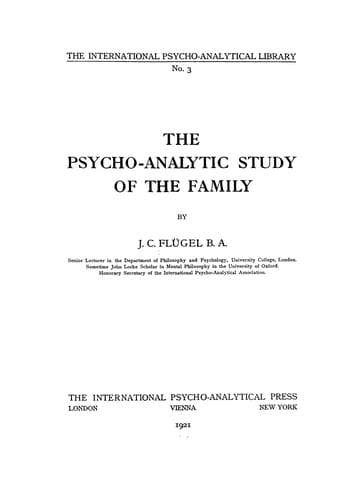
The psycho-analytic study of the familyFlugel, J. C. (John Carl)
Science
The psycho-analytic study of the family
Flugel, J. C. (John Carl)
Families; Marriage; Parent and child; Psychoanalysis
There is a considerable amount of evidence to show that exogamy, where now
in force, was preceded by a period in which the unions prohibited under
its rule were freely indulged in, though the marriage tie was at the same
time broader and less binding. Thus of the Central Australians Spencer
and Gillen[231] say that tradition "seems to point back to a time when
a man always married a woman of his own totem. The reference to men and
woman of one totem always living together in groups would appear to be too
frequent to admit of any other satisfactory explanation. We never meet in
tradition with an instance of a man living with a woman who was not of his
own totem." The same conclusion as to the former universal prevalence of
endogamy emerges from a study of the actually observed condition of the
Australian natives, the rude and uncultivated tribes of the interior being
still to some extent endogamic, while there is a gradual increase in the
frequency and strictness of exogamy, as we proceed from these to the more
advanced communities of the north[232]. Among the Kacharis of Assam we
have an example of what is probably the still more primitive process of a
_compulsory_ endogamy giving place to freedom to marry outside the totem
group, endogamy being here thus not only permitted but enjoined[233].
Other indications of the co-existence of endogamy with a totemic system
are found in Madagascar[234] and in N.W. America[235].
[Sidenote: Really primitive races mostly monogamous and endogamous]
Frazer supposes that exogamy in its beginning arose originally as
a restriction upon complete promiscuity, though he admits that such
promiscuity need not have been characteristic of absolutely primitive
man[236]. As a matter of fact the most primitive races that we know
seem to be usually _monogamous_ and _endogamous_. This is for instance
to a greater or less extent the case with the Veddahs[237], the
Andamanese[238], the lowest forest tribes of Brazil[239], the inhabitants
of the interior of Borneo[240], the Semangs and Senoi of the Malay
Peninsula[241], and the Negritos of the Philippines[242] and Central
Africa[243].
[Sidenote: The family is therefore their principal social unit]
[Sidenote: Incest a natural consequence of such conditions]
Public-domain text, read in full here on John Shaqi.
Reviews
Reviews
No reviews yet
Be the first to share your thoughts on this work.
Elsewhere in the archive
Join the Discussion
Join the discussion
Sign in to leave a comment or review.
Sign InorCreate an account