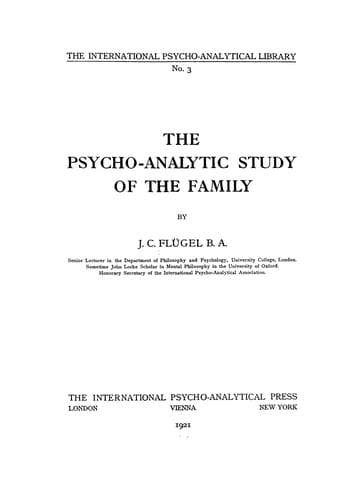
The psycho-analytic study of the familyFlugel, J. C. (John Carl)
Science
The psycho-analytic study of the family
Flugel, J. C. (John Carl)
Families; Marriage; Parent and child; Psychoanalysis
(5) Turning to factors that have in general received less explicit
recognition at the hands of the authorities who have written on the
subject, we may note first that as regards the most fundamental type
of incest as revealed by psycho-analytic study--that of parent and
child--there is involved a sort of biological absurdity, which may well
have been to some extent instrumental, through the agency of natural
selection, of bringing about that inhibition of the incestuous tendencies
for which we have to account. Parents and children necessarily differ
considerably in age, though less so in most primitive communities than in
the civilised societies of to-day, where marriage is so often postponed
till relatively late in life. Even among primitive peoples however the
difference is very appreciable, especially in view of the fact (which must
be borne in mind in this connection) that with such peoples, owing to the
harder conditions of existence, life is often shorter than in civilised
communities, while the enfeeblement that accompanies advancing age comes
on proportionately sooner. If men were to follow blindly the impulses
manifested in the primitive and fundamental forms of incest tendency, sons
would cohabit with their mothers, daughters with their fathers. In such
unions one of the partners would be relatively aged, and the offspring
would in consequence very probably be lacking in that degree of vitality
or health normally possessed by the children of parents of more equal age;
they would moreover fail, in the majority of cases, to enjoy that degree
of provision and protection which could be afforded where _both_ parents
are still youthful. Even if such unions were to occur, they could not (in
the case of one sex at any rate) be continued in the following generation;
for if a son were to cohabit with his mother and if a male child resulted
from their union, this child could not in turn fruitfully unite with his
mother (who would also be his grandmother), as she would be now definitely
past the reproductive age. Further, such unions would come into opposition
with the almost universal tendency to find sexual attractiveness in
youthful rather than in aged persons--a tendency which, like the
appreciation of beauty in the opposite sex in general, we may suppose has
been shaped largely, if not wholly, by the operation of natural selection,
which has ensured that men and women should in the main be attracted to
those who are most likely to produce strong and healthy children.
Public-domain text, read in full here on John Shaqi.
Reviews
Reviews
No reviews yet
Be the first to share your thoughts on this work.
Elsewhere in the archive
Join the Discussion
Join the discussion
Sign in to leave a comment or review.
Sign InorCreate an account