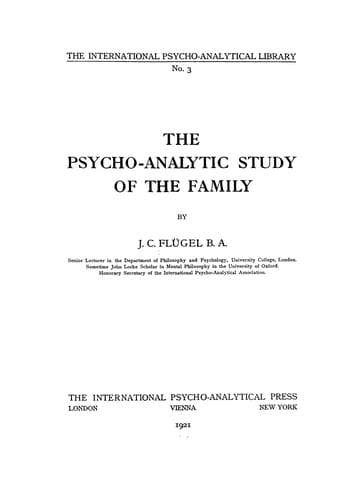
The psycho-analytic study of the familyFlugel, J. C. (John Carl)
Science
The psycho-analytic study of the family
Flugel, J. C. (John Carl)
Families; Marriage; Parent and child; Psychoanalysis
In consequence of this lesser liability to repression, any failure in
development as regards the aspects in question will usually manifest
itself in a positive rather than in a negative form. In so far as the
failure is of the nature of a simple arrest or regression as distinct
from a displacement (cases of which will, in pursuance of our programme,
be considered later), its manifestations consist therefore, for the
most part, of certain characteristics proper to an earlier stage of
development, but which should have been outgrown in the process of normal
adaptation to adult life, and which, when persisting in an individual of
mature years, constitute, as has been sufficiently shown in the earlier
chapters, a serious obstacle to the full enjoyment of a useful and
successful life.
The attitude of the individual towards his life and work may nevertheless
be affected in a certain number of ways which are less obvious in
nature and which may therefore well be mentioned here, especially as
a considerable degree of light has been thrown upon them by recent
psycho-analytic research.
[Sidenote: The influence of heredity]
In the first place it must be recognised that the degree of independence
developed by an individual and the amount of energy and self-reliance
with which he faces the difficulties of life, is apt to depend to a very
considerable extent upon the degree of development of these very same
qualities in one or both of the parents. No doubt, so far as concerns
direct inheritance of mental characteristics, there is a tendency, here
as elsewhere, for the child to develop qualities similar to those of
his parents. This inherited tendency may moreover be reinforced as the
result of precept and imitation, the child tending naturally to follow his
parents' instruction and example; especially in so far as he admires and
envies them or (as almost inevitably happens to a greater or less extent)
so far as he--consciously or unconsciously--comes to regard them as ideals
to which he may himself hope one day to approximate.
[Sidenote: Psychological influences may cause strong]
[Sidenote: parents to have weak children or vice versa]
Public-domain text, read in full here on John Shaqi.
Reviews
Reviews
No reviews yet
Be the first to share your thoughts on this work.
Elsewhere in the archive
Join the Discussion
Join the discussion
Sign in to leave a comment or review.
Sign InorCreate an account