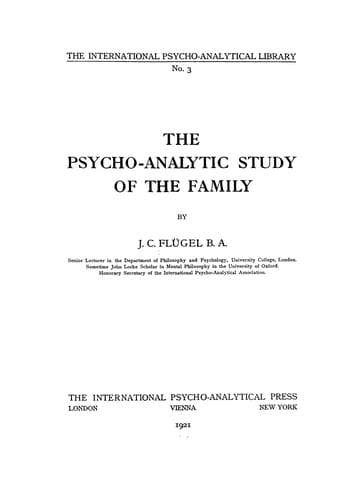
The psycho-analytic study of the familyFlugel, J. C. (John Carl)
Science
The psycho-analytic study of the family
Flugel, J. C. (John Carl)
Families; Marriage; Parent and child; Psychoanalysis
Another way in which parents may influence the general attitude to
life adopted by their children is through the direct--but for the most
part unconscious--identification by the latter of themselves with
their parents. We have already referred to the conception frequently
entertained by children of their parents as ideals of humanity,--ideals
the attainment of which may become a constant source and driving power of
effort. We have seen too in the last chapter some of the evidence for the
potency of this ideal and the constancy with which it may be cherished.
This ideal, however, frequently serves not only as a means of leading
the child to embrace some general standard or mode of life, but, more
specifically also, as an incentive to the adoption of the particular
kind of business, profession, hobby or amusement followed by the parent.
Influence of this sort is of course of especial importance in so far as
it affects the choice of a calling in life, and there can be little doubt
that in a large number of cases a son adopts his particular means of
earning his livelihood as the result of an unconscious or semi-conscious
identification of himself with his father. Sons may also identify
themselves with their mothers as regards their principal pursuits in
life; and (especially under present conditions when work of almost every
description is open to women) daughters with either their fathers or their
mothers. In other cases again the choice is made in order to carry out
some wish--expressed or implied--on the part of the parent[44], or from a
pious desire to carry on some work begun but not completed by the parent.
[Sidenote: Desire to be different from the parent]
In still other cases, however, a desire to be different from the parent
rather than a desire to resemble him may be decisive. When this is so,
the calling chosen will probably be very far removed in character from
the parental one, except in so far as it may resemble it through being
the exact contrary, where such a thing is possible; as for instance in
politics or in opposing schools of social, philosophic or religious
thought. The adoption of such a course depends naturally upon hatred
and aversion instead of love and admiration, and is due as much to a
desire to oppose the parent as to the wish to avoid resembling him. It
is especially liable to occur in cases where the occupation or general
behaviour of the parent has intruded itself in an irksome and insistent
manner into the life of the child; and may lead not only to a dislike of
the parent's occupation itself, but to an opposition to the whole point of
view engendered by such an occupation, as the proverbial tendency to loose
living on the part of the sons of clergymen well illustrates[45].
Public-domain text, read in full here on John Shaqi.
Reviews
Reviews
No reviews yet
Be the first to share your thoughts on this work.
Elsewhere in the archive
Join the Discussion
Join the discussion
Sign in to leave a comment or review.
Sign InorCreate an account