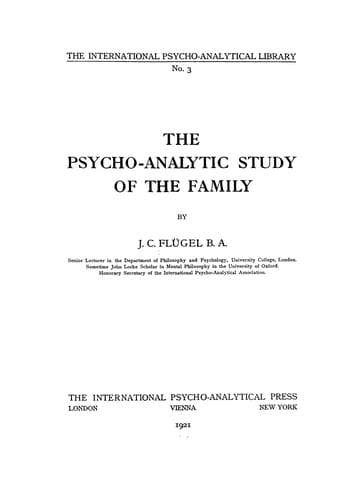
The psycho-analytic study of the familyFlugel, J. C. (John Carl)
Science
The psycho-analytic study of the family
Flugel, J. C. (John Carl)
Families; Marriage; Parent and child; Psychoanalysis
[Footnote 69: It is a question of considerable psychological interest,
as to how the ideas of birth and intra-uterine life come to acquire
the significance which we have found them to possess. In what way for
instance do we come to associate life within the womb with freedom from
effort, difficulty or danger? In the majority of cases, not from conscious
thinking on the subject; on the contrary, the connotation of safety and
effortlessness would seem in some way to belong inherently to the idea
of pre-natal existence from the very beginning, or at any rate to have
become attached to it through a purely unconscious process of association.
Again, how do we come into possession of the ideas of birth and pre-natal
life themselves? Is the knowledge which has gone to the formation of these
ideas entirely acquired after birth, or is there retained in the mind
anything in the nature of impression or memory of that early period of
existence in which gestation and birth were actually experienced? From
the fact of the very general obliviscence which attends the first years
of infancy, as well perhaps as from the relatively undeveloped state
of the cerebrum in the newly born child, we might, with considerable
show of reason, be inclined to disbelieve that any memory traces can be
operative. On the other hand, the surprising fact of the sudden recovery
in hypnosis, during psycho-analysis or otherwise, of early memories which
had been entirely lost for many years, or again the fact that phantasies
of birth or intra-uterine life seem sometimes to refer to details (_e.
g._ the amniotic fluid or the different stages of labour) of which there
is little opportunity to learn in ordinary life and which play but a
small part, if any, in the average adult's conscious notions on these
subjects, have made some writers hesitate to affirm too strongly the
absolute impossibility of such operation. Again some may suggest that the
knowledge which is mysteriously revealed in these phantasies may compel us
to assume the existence of some such innate ideas as are perhaps involved
in Jung's conception of the impersonal or racial Unconscious, according
to which there are present in the unconscious mind certain materials
(capable, apparently, of crystallisation into ideas of a certain degree
of definiteness) which in their origin are assumed to be independent
of personal experience, being, like our more fundamental instincts and
tendencies, derived and inherited from a long line of ancestors.
It is perhaps possible that more exact information on this important
subject might be forthcoming as the result of careful investigations into
such questions as the following:
(1) To what extent (if at all) do children display--in dreams, phantasies
or otherwise--knowledge as to the circumstances of their birth and
pre-natal life which they could not possibly have obtained except from
memory of their own past experience?
Public-domain text, read in full here on John Shaqi.
The psycho-analytic study of the family — John Shaqi
Reviews
Reviews
No reviews yet
Be the first to share your thoughts on this work.
Elsewhere in the archive
Join the Discussion
Join the discussion
Sign in to leave a comment or review.
Sign InorCreate an account