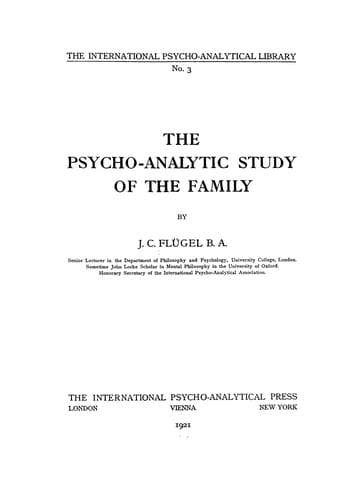
The psycho-analytic study of the familyFlugel, J. C. (John Carl)
Science
The psycho-analytic study of the family
Flugel, J. C. (John Carl)
Families; Marriage; Parent and child; Psychoanalysis
The hostile attitude of the older members of the community towards the
novices, which finds an outlet in the cruelties practised at initiation,
does not however spring exclusively from sexual jealousy on the part of
the elders, but also to some extent from the disinclination which they
feel to admitting the youths--at any rate without some payment--into the
numerous secrets and privileges from which they have hitherto excluded
them, and from the general tendency to grudge the abandonment of that
superiority over the youths which they themselves have hitherto enjoyed.
The manifestation of these feelings in some form of cruelty is most often
rationalised as a desire to prove that the novices are worthy of admission
to the privileges and responsibilities of the initiated and to ensure, by
adding to the impressiveness of the occasion, that they will remember what
they have seen and heard during the initiation ceremonies[80]. Similar
motives, leading to similar manifestations, may often be observed even in
highly civilised communities, where the initiation is usually one destined
to introduce the individual not into adult life in general but into
some special class, institution or society, or into some corporate body
consisting of persons who have enjoyed some special kind of experience
or mode of life. Under this head, for instance, come many of the time
honoured customs and ceremonies, to which boys on entering school or
joining a "gang", students on going to college, or persons joining some
professional society or guild, are made to submit[81].
[Sidenote: Prohibition and licence]
In other aspects of the ceremonies, however, the motive of sexual jealousy
stands unmistakably displayed. Thus the rites of circumcision and
subincision, the pulling out of hairs from the head, face or pubic region
and the knocking out of teeth, which so frequently precede or accompany
the process of initiation, are all symbols of castration; a penalty
which it is desired to inflict--really or symbolically--from a number of
distinct though closely connected motives, the most important being:--(1)
as a means of rendering impossible the realisation of forbidden sexual
cravings, (2) as a threat to show that the power of the elders still
exists and that it will be exercised should the prescribed limits be
overstepped, (3) as a punishment for past incestuous desires or acts (as
is shown, for instance, in the superstition that if the wound caused by
circumcision does not readily heal it is because the youth has already
been guilty of incestuous connection[82]). The same object of preventing
incest is sought in the stern "avoidances" which are often practised at
the same time; as, for instance, that by which a youth must keep very
carefully from all contact with his mother, even to the extent of avoiding
her footprints.
Public-domain text, read in full here on John Shaqi.
Reviews
Reviews
No reviews yet
Be the first to share your thoughts on this work.
Elsewhere in the archive
Join the Discussion
Join the discussion
Sign in to leave a comment or review.
Sign InorCreate an account