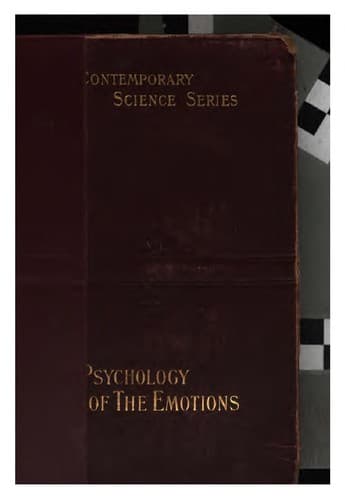
The Psychology of the EmotionsRibot, Th. (Théodule)
Science
The Psychology of the Emotions
Ribot, Th. (Théodule)
Emotions
Let us turn to primitive man. The question becomes less simple; but
the physical element still preponderates. Music consists only of
rhythm, marked by clumsy and noisy instruments, whose principal
effect is to increase the vibration of the nervous system. The
aborigines of America are able, during four consecutive hours, to
intoxicate themselves with rhythmic sounds having no melodic
significance. Among certain tribes, diviners and sorcerers employ
the drum in order to produce in themselves a sort of ecstasy;[74] it
is a true intoxication through sound, and especially through
motion—_i.e._, an affective state excited directly by external and
internal sensations. We have here before us the genesis of emotion.
-----
Footnote 74:
For details on this point, Wallaschek’s interesting work on
_Primitive Music_ should be consulted.
-----
Civilised man, exceptions apart, is sensitive to music in different
degrees, from the peasant or artisan, who, like the savage, prefers
tunes with a well-marked rhythm, to the most cultivated amateur. But
for all states the primary effect is a physical one. “Musical
vibration is only one particular mode of perceiving that universal
vibration—that music of life which animates all beings and all
bodies, from the lowest to the highest. From this point of view,
musical art may be called the art of sensibility _par excellence_,
since it regulates the great phenomenon of vibration, into which all
external perceptions resolve themselves, and transfers it from the
region of the unconscious, in which it was hidden, to that of
consciousness.”[75] Music acts on the muscular system, on the
circulation, the respiration, and the parts dependent on them.
Intense sounds (the big drum, kettledrum, etc.) give the whole body
a shock, over-acute sounds cause muscular contractions. I know a
musician who is thrown into convulsions by too marked a discord. Let
us add to these the well-known effects of horripilation, of thrills
passing down the back or over the scalp, of sudden sweats, of
tickling, of epigastric constriction. Grétry had already noted that
the pulse is sensitive to rhythm; and he has recorded several
observations made on himself, showing that the pulsations are
accelerated or retarded according to the rhythm of a chant heard
internally. It would be an interminable task to enumerate the purely
physical effects of the musical impression. The conclusion to be
drawn is, that while certain arts at once awaken ideas which give a
determination to the feelings, this of music acts inversely. It
creates dispositions depending on the organic state and on nervous
activity, which we translate by the vague terms—joy, sadness,
tenderness, serenity, tranquillity, uneasiness. On this canvas the
intellect embroiders its designs at pleasure, varying according to
individual peculiarities.
-----
Footnote 75:
Beauquier, _op. cit._, p. 56.
-----
Public-domain text, read in full here on John Shaqi.
Reviews
Reviews
No reviews yet
Be the first to share your thoughts on this work.
Elsewhere in the archive
Join the Discussion
Join the discussion
Sign in to leave a comment or review.
Sign InorCreate an account