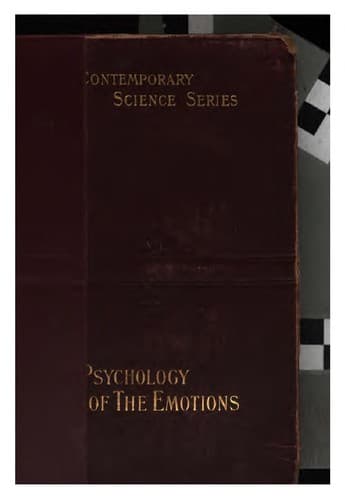
The Psychology of the EmotionsRibot, Th. (Théodule)
Science
The Psychology of the Emotions
Ribot, Th. (Théodule)
Emotions
1. The brain is not merely the echo of internal sensations; it
receives and reacts according to its disposition; it centralises,
but while taking its own part in the concert; it puts its mark on
the impressions it receives. Already (Chap. I., § 1) we have seen
the theories propounded as to the “seat” or “centre” of pain or
pleasure: bulb, protuberance, temporal lobe, occipital lobe, etc.
Naturally, each author has extended his hypothesis to the emotions
properly so called. However, the search for “emotional centres”
appears still more chimerical. A particular emotion has no
determinate centre, is not localised in a restricted area of the
encephalon. Not only does neither observation nor experience
indicate anything of the sort, but if we consider the complexity of
any emotion whatever, we shall understand that it requires the
activity of several cerebral and infra-cerebral centres: (1) the
sensory centres of sight, hearing, smell, etc.; (2) the centres
scattered through the motor zone and regulating the movements of
different parts of the body; (3) and lastly, the centres
corresponding to the phenomena of organic life. These constitute
several stages: in the spinal cord, the respiratory centre, that
which accelerates the movements of the heart, the genito-spinal, the
vesico-spinal (it is well known that the bladder is as good an
æsthesiometer as the iris), etc.; in the bulb, the respiratory and
vaso-motor centres, and those of cardiac and thermic inhibition. As
regards the cortical layer, there are many open questions as to the
position of the vascular, thermic, trophic, glandular centres, of
the organic movements which determine the contraction of the
intestines, the bladder, the spleen, etc. This very incomplete and
confused enumeration is sufficient for our purpose—viz., to show
that we must speak, not of a centre, but of the synergic action of
several centres, differently grouped according to the cases.[80]
Footnote 80:
In his lectures on Hysteria (Vol. i., Lecture 21), Pitres
incidentally inquires into the existence of encephalic centres of
the affective states, and concludes that “the molecular changes
corresponding to the activity of the cellular elements shaken by
the passions, radiate in every direction, stimulate or depress the
excitability of adjacent elements, rebound on the motor and
sensitive centres, and on the originatory nuclei of the visceral
nerves, and finally determine the state of emotion, _i.e._, the
psycho-physiological state which is the special expression of the
reaction of the nervous centres to psychic excitations.”
Public-domain text, read in full here on John Shaqi.
Reviews
Reviews
No reviews yet
Be the first to share your thoughts on this work.
Elsewhere in the archive
Join the Discussion
Join the discussion
Sign in to leave a comment or review.
Sign InorCreate an account