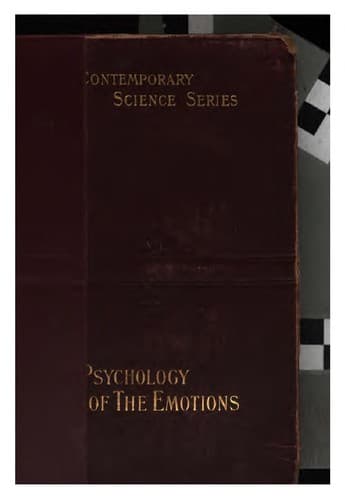
The Psychology of the EmotionsRibot, Th. (Théodule)
Science
The Psychology of the Emotions
Ribot, Th. (Théodule)
Emotions
2. But there are also the substances which the living body compounds
or modifies for itself. It has been said that the organism is the
receptacle and laboratory of poisons; in the state of emotion, the
only one with which we are concerned at present, the function of
this chemical process is manifested at every instant. We are always
speaking of the weakening or the increase of the circulation of the
blood; yet the emotional dispositions or modifications are
connected, not only with variations of quantity, but also with those
of _quality_ in the blood (anæmia, aglobulia, malarial poisoning,
etc.). The popular expression regarding the emotions which “curdle
the blood” is not so ridiculous as it might seem. Anger, fear,
fatigue are often accompanied by changes in the intimate
constitution of the sanguinary fluid. We may incidentally note the
ascertained relations between certain cardiac affections and
affective dispositions: in aortic affections, anæmia, excitement,
irritability; in cases of mitral insufficiency, congestion, and a
taciturn and melancholy humour. We shall elsewhere have occasion to
enumerate the facts which show the correlation of certain emotions
with toxic changes in the saliva and the lacteal secretion.
Perspiration may, in certain affective states, be coloured red,
yellow, green, or blue, not to mention the varieties of odour, which
are assuredly of chemical origin. Even apart from mental disease,
the urinary secretion could furnish a long list of chemical changes
(azoturia, oxaluria, phosphaturia) coinciding with variations of the
affective order, such as apprehension, melancholy, irritability. In
gouty and rheumatic patients, the modifications of temper, depending
much more on general nutrition than on active suffering, have often
been pointed out. We know the relations between the secretion of the
gastric juice and pleasurable or painful states; dyspeptics have a
well-established reputation for being neither cheerful nor
comfortable to live with. Beaumont ascertained, in the case of his
famous Canadian, that under the influence of anger or other very
strong emotions, the lining of the stomach was irritated, became
red, dry, and very sensitive, and an attack of indigestion was the
result. The rutting time (that of sexual excitement) is, in many
animals, accompanied by deep-seated chemical changes, showing
themselves externally by modifications of colour and odour, and,
internally, not limited to the sexual organs, but extending to the
whole of the body. It is known that the flesh of game is uneatable
during this period, and that many fish, at spawning-time, become
poisonous. It should not be forgotten that, during the same period,
the animal becomes vicious, violent, aggressive, and dangerous. It
would be easy to develop this point further, even as regards man
(puberty, gestation, lactation, menstruation).
Public-domain text, read in full here on John Shaqi.
Reviews
Reviews
No reviews yet
Be the first to share your thoughts on this work.
Elsewhere in the archive
Join the Discussion
Join the discussion
Sign in to leave a comment or review.
Sign InorCreate an account