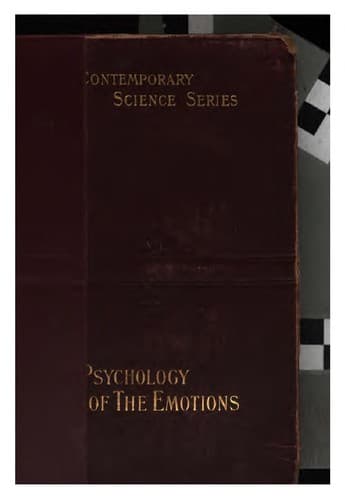
The Psychology of the EmotionsRibot, Th. (Théodule)
Science
The Psychology of the Emotions
Ribot, Th. (Théodule)
Emotions
When treating of pleasure and pain, we remarked that they were too
exclusively attributed to intensity of excitation (excessive, it was
said, for pain; moderate, for pleasure), and that its _quality_ was
forgotten. Since we have to do with hypotheses as to the part played
by chemical conditions in affective life, since they are the most
general, and since pleasure and pain also have this character of
generality, it may be permitted to hazard a conjecture. This would
consist in admitting that pleasure arises either when excitement
increases chemical activity in the organism, without producing
toxines, or when this augmentation of activity brings about the
disintegration of the normal poisons; and that pain arises either
when excitement creates an environment appropriate to the formation
of toxines, or when, directly and at once, it promotes their
formation, either generally or locally. But I would not insist on a
simple _obiter dictum_, for which I can offer no proof, thrown out
merely as a suggestion with regard to a question not as yet fully
examined.
We have spoken throughout of the chemical modifications as
coinciding with emotional changes. Are they effects or causes, or
both, according to circumstances? It is clear that this question is
not new to us. It is the antithesis between the psychological and
physiological theories of emotion, presenting itself under another
aspect; there is no occasion for discussing it a second time.
CHAPTER IX.
THE EXTERNAL CONDITIONS OF EMOTION
_Empiric period—Pre-Darwinian period of scientific
research—Examination of Darwin’s three principles—Wundt and his
explanatory formulas: Innervation directly modified, Association
of analogous sensations, Relations of motion with sensory
representations._
The movements of the eyes, mouth, face, the upper and lower limbs
and trunk, and the modifications of the voice constitute the
external expression of emotion which is principally reducible to
muscular action. For the last half-century this subject has been
studied in works so well known that it behoves us to be very brief.
I shall confine myself to indicating the actual state of the
question.
Public-domain text, read in full here on John Shaqi.
Reviews
Reviews
No reviews yet
Be the first to share your thoughts on this work.
Elsewhere in the archive
Join the Discussion
Join the discussion
Sign in to leave a comment or review.
Sign InorCreate an account