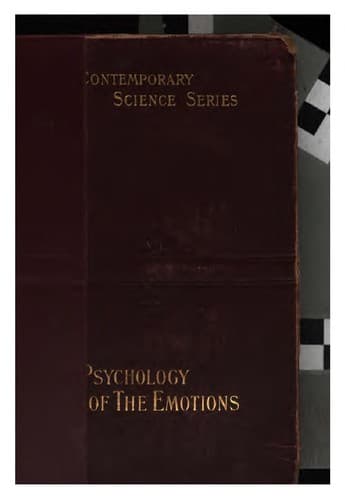
The Psychology of the EmotionsRibot, Th. (Théodule)
Science
The Psychology of the Emotions
Ribot, Th. (Théodule)
Emotions
_Their discrepancies—Reduced to three types: (1) Classification
of pleasures and pains—(2) Classification of emotions: two
forms, empiric and analytico-comparative—(3) Classification
of representations, intellectualist form—Critical
remarks—Impossibility of any classification._
The confusion of that department of psychology which deals with the
feelings and the vagueness of its terminology appear in all their
fulness with the problem of classification. Although, for reasons
which will be given at the end of the chapter, a complete and
satisfactory classification seems to me impossible, there has been
no lack of attempts, and it must be admitted that they are not
illegitimate, at any rate as approximative efforts towards a
provisional order.
Within the last fifty years, in spite of the very moderate amount of
zeal with which psychologists have studied the feelings, we find
about twenty treatises signed by well-known names, not to mention
minor variants.[90] They are far from being in agreement, except on
some few points, and when they are compared, in order, if possible,
to reconcile them, the first impression is one of inextricable
confusion and hopeless divergence. If we examine them a little more
carefully, we begin to see light. We see that the differences are
only in the objects classed and the methods followed; in one word,
it is possible to attempt a classification of these classifications;
and when this is done, we find, if I am not mistaken, that they can
all be reduced to three types. (1) Some writers, virtually, classify
only pleasures and pains, tracing back the whole of affective life
to their modalities. (2) Others classify the emotions properly so
called; and here we must distinguish two groups, according as the
method employed is purely empiric, and founded on current
observation, or has recourse to analysis and genetic research, after
the manner of the so-called natural classifications. (3) Lastly,
others classify intellectual states pure and simple, and,
conversely, the affective states which accompany them: this is the
intellectualist method.
Footnote 90:
For a historical summary of these classifications, consult
especially Sully, _The Human Mind_, vol. ii., Appendix F, p. 357,
and Bain, _Emotions_, Appendix B.
In order to justify our distinction, we shall successively examine
these three types. This excursion on an ungrateful soil will not be
altogether without, at least, a negative utility.
I.
As many writers show a common tendency to reduce the whole of the
affective life to pleasures and pains, considered as essential and
fundamental phenomena, it is natural that one category of
classifications should have been based upon these.
Public-domain text, read in full here on John Shaqi.
Reviews
Reviews
No reviews yet
Be the first to share your thoughts on this work.
Elsewhere in the archive
Join the Discussion
Join the discussion
Sign in to leave a comment or review.
Sign InorCreate an account