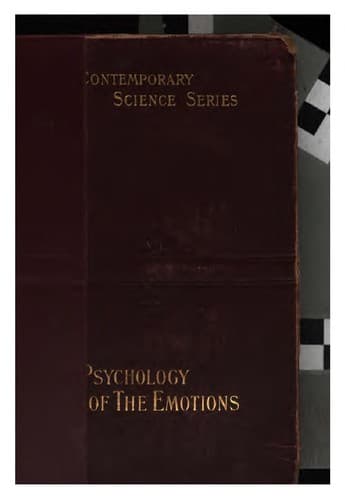
The Psychology of the EmotionsRibot, Th. (Théodule)
Science
The Psychology of the Emotions
Ribot, Th. (Théodule)
Emotions
Bain may be cited as one of the principal representatives of this
method. I will not insist on a piece of work unworthy of such a
psychologist; yet he has done it twice over, without arriving at an
agreement with himself.
His earlier classification gives as fundamental the emotion of
relativity (surprise, astonishment), terror, tenderness,
self-esteem, anger, the sense of power, of activity, of mental
exercise, æsthetic emotion, moral emotion.
The later includes eleven groups: love, anger, fear, the sentiment
of property, the pleasure of power and its correlative pain of
subjection, pride, vanity, activity (“plot-interest”), knowledge
(the intellectual feeling), æsthetic emotion (beauty), moral
sentiment. Three of these are “simple”—anger, love, and fear; but we
find, a little later on, that love and anger are called “the giants
of the group, the commanding and indispensable members of the
emotional scheme;” so that fear would seem to be eliminated.
The incoherence and inconsistency of this attempt are sufficiently
obvious, and I need not insist on them. (It should be noted that, in
both cases, the religious sentiment is omitted.) I can find only one
valuable remark—viz., that “pleasures and pains are contained in
every one of the classes to be described, just as the natural orders
of plants may each contain food and poison, sweet aromas and
nauseating stinks.”[92] I have only referred to this classification
in order to show how, by its very nature, it is condemned to
failure. Floating at haphazard, without fixed principle, when not
contradictory, it can only be arbitrary.
Footnote 92:
Bain, _The Emotions and the Will_, p. 76.
Herbert Spencer has criticised it in a well-known passage, which I
will briefly recapitulate, since it serves as a transition to the
second form of classification, and throws some light on the
latter.[93] Bain has overlooked the fact that in confining his
attention to the most obvious characteristics of the emotions, he is
following the method of the ancient naturalists, who classed the
cetacea among fishes. Every classification should be preceded by a
rigorous analysis. For this purpose it would be necessary, as a
preliminary, to study the ascending evolution of the emotions
through the animal kingdom, to find out which of them are the first
to appear, coexisting with the lowest forms of organisation and
intelligence, and to note the existing differences, as regards
emotion, between the higher and lower human races. Those common to
all may be considered as simple, and those peculiar to the civilised
races as ulterior and derivative.
-----
Footnote 93:
H. Spencer, _Essays_, vol. i. (Library Ed., 1891), pp. 241-264.
-----
Public-domain text, read in full here on John Shaqi.
Reviews
Reviews
No reviews yet
Be the first to share your thoughts on this work.
Elsewhere in the archive
Join the Discussion
Join the discussion
Sign in to leave a comment or review.
Sign InorCreate an account