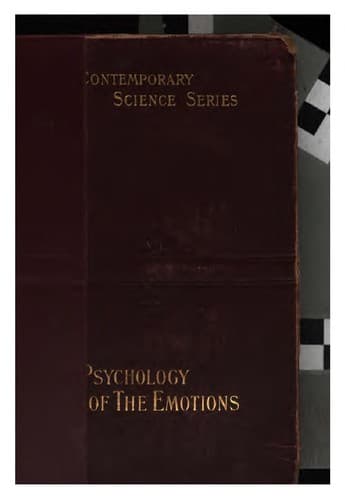
The Psychology of the EmotionsRibot, Th. (Théodule)
Science
The Psychology of the Emotions
Ribot, Th. (Théodule)
Emotions
Even when all details are omitted, the general drift of this work
must be sufficiently apparent to the reader. Although conducted
according to a fixed method, it does not escape the difficulties
inherent in _every_ classification of the emotions. In the first
place, the order of filiation is not always very well marked. The
author himself recognises that an arrangement in series is not
possible, but this difficulty has also presented itself in zoology
and botany. We meet with repetitions, _i.e._, forms of sentiment
figuring several times over in different categories. This, too, is
inevitable. The complex emotions (or some of them, at least) are
formed by anastomoses: they are rivers formed by converging streams
coming from various sources lying in different directions. One may
legitimately refer them to one or other of these origins; but the
attribution will be partial and arbitrary. The religious sentiment,
for instance, is included in the class of intellectual emotions. But
its social character is undeniable (a point we shall return to in
the proper place); let us recall, in passing, the worship of
ancestors and deified heroes, and the strictly national religions of
antiquity, the communities, orders, confraternities, corporations,
the missionary work carried on in modern times, and, above all, the
contagious character of religious emotion in general. It is false,
moreover, to say that this emotion “tends neither to the
preservation nor the destruction of the individual.” It might
therefore be just as well—or just as ill—placed in the third class.
As soon as we pass from simple to complex emotions, it is of more
importance to determine their composition than their filiation. Now,
this procedure belongs rather to chemical than to zoological
classification.
III.
A third type of classification, peculiar to the intellectualists,
consists in classing according to the intellectual states, in so far
as these are accompanied by affective elements. This system sprang
from the psychology of Herbart, is based on it, and is met with in
the works of the principal representatives of his school, Waitz,
Drobisch, and especially Nahlowsky in _Das Gefühlsleben_ (pp. 44 _et
seq._). This method is peculiar to Germany, and its influence is
still perceptible even in Wundt, and more recently in Lehmann’s book
(_op. cit._, pp. 338 _et seq._). In England, Shadworth Hodgson
approaches this type.
Apart from the procedure common to all, these classifications agree
still less in detail than those of the first two types. Taken
broadly, they have an academic aspect; they are frittered away in
divisions, sub-divisions, distinctions, whence there arises more
darkness than light. There is, however, a dichotomy peculiar to them
corresponding to a reality which is not met with in the two
previously-mentioned types, and, on this account, deserves notice.
Public-domain text, read in full here on John Shaqi.
Reviews
Reviews
No reviews yet
Be the first to share your thoughts on this work.
Elsewhere in the archive
Join the Discussion
Join the discussion
Sign in to leave a comment or review.
Sign InorCreate an account