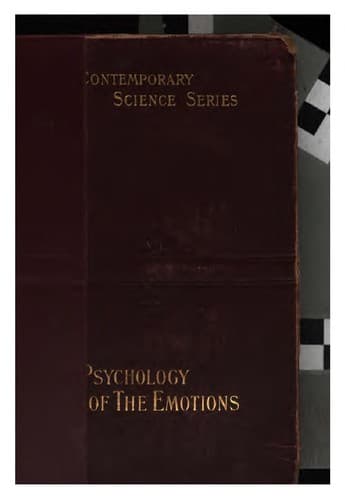
The Psychology of the EmotionsRibot, Th. (Théodule)
Science
The Psychology of the Emotions
Ribot, Th. (Théodule)
Emotions
It was for this reason that I proposed to myself the task of
collecting fresh documents, and of inquiring whether there are not
great differences between one individual and another as regards the
memory of impressions. This would explain the want of harmony among
authorities on this point.
Having eliminated all vague and doubtful answers, and those which
are not to the point, I have collected about sixty _dossiers_. Each
person (all being adults, of both sexes, and various stages of
culture) was directly questioned by myself, and the answers
immediately noted. Besides these, I have received several long
written communications, which I reckon among my best material. The
nature of the questions asked will be sufficiently evident from the
following summary, which contains the principal results of my
inquiry. I shall confine myself to a bare statement of the facts;
the interpretation will come later.
1. _Images of taste and smell._—I was disposed to admit that they
are not subject to any spontaneous revivability, and still less to a
voluntary one, being, for my own part, quite incapable of recalling
a single one, even in the faintest degree. The answers have put me
completely in the wrong—the negatives being 40 per cent., the
positives 60 per cent. More accurately, 40 per cent. persons revive
no image, 48 per cent. revive some, 12 per cent. declare themselves
capable of reviving all, or nearly all, at pleasure.
The majority of cases, therefore, allows of the spontaneous revival
of some odours only. Those most frequently mentioned are pinks,
musk, violets, heliotrope, carbolic acid, the smell of the country,
of grass, etc. The conditions under which the image appears are
various. For some persons this is unaccompanied by any visual,
tactile, or other representation. With the majority, the imaginary
odour ultimately excites the corresponding visual image (that of a
flower, a bottle of scent, etc.). Many have first to evoke the
visual image, and, in time, succeed in exciting the olfactory one.
Two individuals affirm that, on reading the description of a
landscape, they immediately perceive the characteristic odours. Here
the sign is sufficient. One of them, a novelist, is sometimes
conscious of thirst under the same conditions.
In the two following cases the “olfactory image” only exists in a
single instance, and appears to be produced by the combined
operation of concomitant circumstances.
Public-domain text, read in full here on John Shaqi.
Reviews
Reviews
No reviews yet
Be the first to share your thoughts on this work.
Elsewhere in the archive
Join the Discussion
Join the discussion
Sign in to leave a comment or review.
Sign InorCreate an account