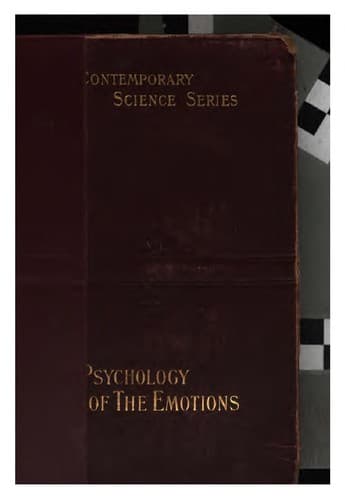
The Psychology of the EmotionsRibot, Th. (Théodule)
Science
The Psychology of the Emotions
Ribot, Th. (Théodule)
Emotions
Galton, in a note entitled “Arithmetic by Smell,” has described an
arrangement by means of which he convinced himself that some
arithmetical operations can be carried out by the help of
olfactory images, as is done by means of visual and auditory
representations. He trains himself to regard two whiffs of
peppermint as equivalent to one of camphor, and three of
peppermint with one of carbolic acid; he performs small additions,
and, later on, operates with images only (visual and auditory
representations being excluded). For details, see _Psychological
Review_, January 1894.
-----
As to the recollections of tastes, by themselves, the answers are
very vague. One remembers “easily, and at will, the taste of salt,
with a very clear visual impression,” but less easily the other
three fundamental tastes. Another, who uses for his throat three
different kinds of lozenges, “feels the taste of them beforehand, as
soon as he needs them, on either seeing or touching them.” In
general, the revivability of tastes appears to me especially
connected with that of ordinary food, and with the state of the
alimentary canal (hunger).
2. _Internal sensations._—My inquiry does not include the whole of
these, but only the commonest and most easily observed.[100]
-----
Footnote 100:
The memory of internal sensations, though distinct from that of
states of feeling properly so called, approximates so closely to
it that the two subjects appear to me inseparable.
-----
As regards hunger, I have received 51 definite answers, 24 persons
saying they can distinctly recall it, 27 that they cannot. (The
question has always been put at an hour when the real sensation did
not exist, and some have told me that in their normal condition they
never feel either hunger or thirst.) It is usually described as a
tactile sensation in the œsophagus, or a twitching pain in the
stomach, etc. One person only affirms that he can, “at will, feel
hunger and thirst, even after having eaten and drunk.”
Thirst is imagined much more frequently than hunger, and, as it
seems, more clearly (36 affirmative to 15 negative answers). It is
described as dryness in the throat, heat, etc.
Public-domain text, read in full here on John Shaqi.
Reviews
Reviews
No reviews yet
Be the first to share your thoughts on this work.
Elsewhere in the archive
Join the Discussion
Join the discussion
Sign in to leave a comment or review.
Sign InorCreate an account