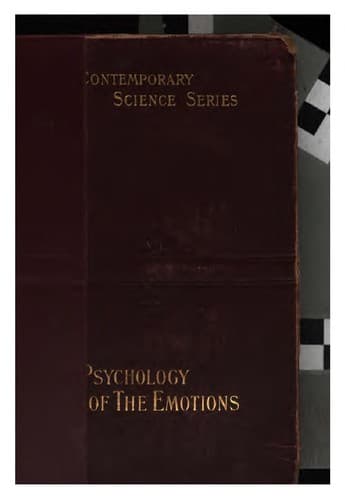
The Psychology of the EmotionsRibot, Th. (Théodule)
Science
The Psychology of the Emotions
Ribot, Th. (Théodule)
Emotions
_The function of the feelings, as the cause of association—The law
of affective association, conceived as general, and as local—I.
Function of unconscious feeling: ancestral or hereditary
unconsciousness; personal unconsciousness arising from
cœnæsthesia; personal unconsciousness arising from the events of
our life—Law of transference by contiguity, by resemblance: wide
or narrow—II. Function of the conscious feelings: accidental
cases, permanent cases, exceptional or rare cases._
In this chapter we have still to deal with the relation between the
feelings and the memory, but under quite another form, seeing that
we have to study the feelings as a _cause_. Instead of establishing,
as we have hitherto done, that there is such a thing as a real
memory of the feelings, our present aim is to determine the function
of states of feeling in the recalling of recollections and the
association of ideas. Their importance as a hidden factor of
revivability has been recognised by several contemporary
writers,[110] some even having a tendency to exaggerate it.
-----
Footnote 110:
I may specially mention Horwicz, _Psychologische Analysen_, vol.
i. pp. 160 _et seq._, 265-331, 369 _et seq._; Fouillée,
_Psychologie des idées-forces_, vol. i. pp. 221 _et seq._; J.
Sully, _The Human Mind_, vol. ii. pp. 76-80; Shadworth Hodgson,
_Time and Space_, p. 266; W. James, _Psychology_, i. 571;
Höffding, _Psychologie_ (2nd ed.), p. 331.
-----
We know that the theory of the association of ideas has been reduced
to two fundamental laws—that of contiguity and that of resemblance.
I may remark, without insisting on the fact, that they are not of
the same nature; the first, being purely mechanical, the result of
experience, while the second supposes, in addition to this, a
certain degree of mental labour, for a complete correspondence
between two states is rarely met with, and can only be grasped in
consequence of a dissociation or abstraction operating on the raw
materials. These two laws are purely intellectual; they are
regulative principles deduced from facts, nothing more. They are
rather descriptive than explanatory. They reveal the mechanism, but
not the motive force. They suppose something beyond, unless we admit
that ideas are psychic atoms endowed with some mysterious attraction
or affinity. With regard to the determining reasons, they are dumb.
Now it cannot be doubted that in many cases (not all) the cause of
the association is to be found in a permanent or momentary state of
the feelings.
The writers who have pointed out this influence (often efficacious
though latent) have conceived this superior law, which might be
called the Law of Feeling, in two different ways, some as absolute
and universal, others as partial and local. I take my stand among
the latter.
Public-domain text, read in full here on John Shaqi.
Reviews
Reviews
No reviews yet
Be the first to share your thoughts on this work.
Elsewhere in the archive
Join the Discussion
Join the discussion
Sign in to leave a comment or review.
Sign InorCreate an account