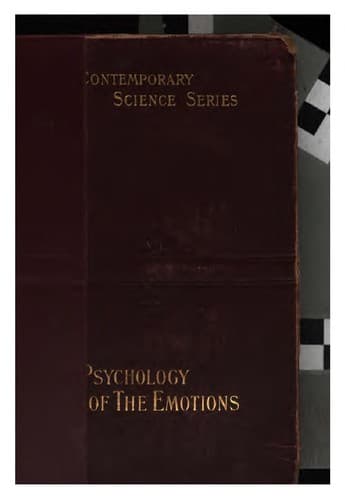
The Psychology of the EmotionsRibot, Th. (Théodule)
Science
The Psychology of the Emotions
Ribot, Th. (Théodule)
Emotions
landscape, by reason of his limited intellectual power. We know that
(in spite of common opinion) a savage, even a barbarian, is not
moved by the splendours of civilised life, but only by its petty and
puerile sides. Its greater aspects inspire him neither with desire,
admiration, nor jealousy, because he does not understand them.
Bougainville, in the last century, had already remarked this fact,
which has frequently been confirmed since. Speaking of the profound
indifference of the Pacific Islanders to the skilled construction of
his ships and the instruments belonging to them, he says, “They
treat the masterpieces of human industry as laws and phenomena of
nature.”
2. Must we admit heredity as a special and independent cause of
emotional evolution? This problem has been hotly debated. Darwin,
Spencer, and many others following them, admit that certain acquired
variations or modifications in the range of the feelings may be
hereditarily transmitted, then fixed and organised in a race. They
give as examples, fear, the benevolent feelings, the love of nature,
the musical sense, etc.; the sudden return of so-called civilised
individuals to savage or nomad life, for want of a hereditary
tendency fixed by the habit of several generations; while the
co-existence of predatory tendencies with the highest culture is for
them a case of atavism or reversion.[124] On the other hand, the
dominant opinion for the last twenty years (I think it shows
symptoms of declining) is radically opposed to the inheritance of
acquired modifications. Weismann and Wallace, who, more than others,
have touched on the psychological parts of this subject, are
decidedly for the negative. The question is therefore an open one,
and I accept it as such, in order to escape the accusation of a bias
in favour of heredity. But even while admitting that there is no
fact strictly conclusive in favour of the transmission of psychic
peculiarities, it nevertheless remains true that some occurrences of
this sort are probable enough, especially in the pathological order.
These belong to the category of appetites, tendencies, and passions,
much more than to the group of intellectual states. This might have
been foreseen, physiological heredity being more stable than
psychological, and physiological conditions affecting the emotional
life much more immediately than the intellectual.
-----
Footnote 124:
For further details, see my _Hérédité psychologique_, Bk. I. chap.
v. and Bk. III. chap. iii. Bain has discussed the question at
great length from the strictly psychological point of view (_The
Emotions_, chap. ii.). He inclines to a “probability” of
transmission in certain cases.
-----
Public-domain text, read in full here on John Shaqi.
Reviews
Reviews
No reviews yet
Be the first to share your thoughts on this work.
Elsewhere in the archive
Join the Discussion
Join the discussion
Sign in to leave a comment or review.
Sign InorCreate an account