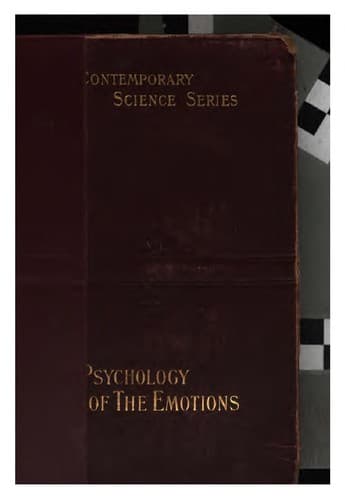
The Psychology of the EmotionsRibot, Th. (Théodule)
Science
The Psychology of the Emotions
Ribot, Th. (Théodule)
Emotions
The nutritive acts take place in the inmost recesses of the tissues
and organs. By what channels are they connected with the cortex,
either when undergoing its influence or transmitting the echoes of
their slackening, accelerative, and other modifications? On this
point physiologists know little. According to some (Schiff,
Brown-Séquard), there are relations between the digestive tube and
the optic layer, the striated body, the cerebral peduncles; the
psychic actions which modify respiration being transmitted through
the third ventricle and the anterior corpora quadrigemina. The
experiments of Pitres and François-Franck on the sensori-motor zone
of the cortex show that excitement, at any given point, results in:
augmentation, retardation, or even arrest of breathing; acceleration
of the cardiac rhythm, and, if powerful, inhibition or even syncope;
vaso-motor effects, a contraction or relaxation of the bladder; an
influence on uterine contractions; on the secretion of the saliva
and the pancreatic juice, and on trophic action in general.
According to Goltz, the destruction of the anterior lobes produces
atrophy, that of the posterior the contrary effect. These
discrepancies and uncertainties are to us of small importance; but
it remains certain that the nutritive functions especially depend on
the pneumogastric and the great sympathetic nerves, that they are in
some manner represented in the cerebral cortex and form the
principal contents of cœnæsthesia. Though in the adult they play
only a latent and intermittent part by reason of the preponderance
of external sensations, images, and ideas, it is probable that in
animals, particularly in voracious ones, the functions are inverted,
and that cœnæsthesia, as a synthesis of the organic functions,
passes to the front rank. This has even been asserted to be the case
in children and savages, the argument being based on the fact that
they have, in proportion, larger stomachs and longer intestines, and
on various other characteristics.[128] However this may be, when
deep-seated disturbances take place in the organism, cœnæsthesia is
modified; which involves modification of the tendencies, and,
consequently, of the position of pleasure and pain.
Footnote 128:
Brugia, _Patologia della cenestesia_ (1893).
Public-domain text, read in full here on John Shaqi.
Reviews
Reviews
No reviews yet
Be the first to share your thoughts on this work.
Elsewhere in the archive
Join the Discussion
Join the discussion
Sign in to leave a comment or review.
Sign InorCreate an account