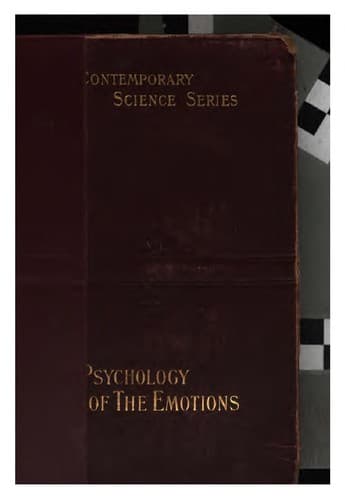
The Psychology of the EmotionsRibot, Th. (Théodule)
Science
The Psychology of the Emotions
Ribot, Th. (Théodule)
Emotions
I must here repeat Briquet’s remark on this point: “However
strange these appetites may appear, their origin can frequently be
discovered. Thus a young woman, who would greedily devour the
embers of her foot-warmer, told me that she had, from the
beginning, been fond of the crust of bread; from this she came to
like the crust of toasted bread, then charred bread, and so
gradually acquired the taste for small pieces of charcoal. I am
inclined to think that, were we to inquire into the origin of many
of these strange tastes, we should find it as simple as the
above.” Pierre Janet (_État mental des hystériques_, ii. p. 71)
transcribes this passage, and adds, “I have often followed this
advice and been in a position to appreciate its value.” This
psychological inquiry is very ingenious, but only removes the
difficulty a stage further back. It shows us through what series
of associations the final result is attained; but association
alone is not sufficient to arrive at this result, still less to
render it permanent. It is only the external mechanism which
explains, at the utmost, why the deviation should have taken this
particular direction. Many persons are fond of crust, even of
burnt crust, who will never come to have the slightest appetite
for charcoal. Many have eaten charcoal out of curiosity, or by
accident, but without acquiring a taste for it. It is some deeper
and more powerful cause than association which lies at the root of
these feelings and renders them active.
There are many instances of hypochondriacs searching for and
devouring with enjoyment worms, toads, spiders, caterpillars, etc.;
and the beginning of insanity is often marked by an eccentric and
disordered dietary.
Again, at a still lower stage, we have coprophagy and scatophagy
(the swallowing of excrements, urine, the contents of spittoons,
etc.), which are rarely, if ever, found in any but idiots and those
suffering from dementia, _i.e._, in beings whose simplest instincts
have been abolished or perverted. The voracity of certain idiots has
been attributed to paralysis of the gastric branch of the vagus
nerve.[130]
-----
Footnote 130:
For details, see Campbell “On the Appetite in Insanity,” in the
_Journal of Mental Science_, July 1886, pp. 193 _et seq._, and
Belmondo, “Pervertimenti dell’istinto di nutrizione,” in
Tamburini’s _Rivista_, 1888, pp. 1 _et seq._, where is cited the
case of an insane patient in whose stomach were found 1841
objects, such as nails, bits of lead, and the like, weighing in
all eleven (English) pounds, ten ounces.
-----
The same would apply to the sense of smell, so intimately associated
with that of taste that it has justly been called “tasting at a
distance.” (We must not, moreover, forget its close connection with
the sex-instinct.) Certain persons, who cannot endure the most
delicate aromas, enjoy the odour of valerian, of asafœtida, and of
still more repulsive substances.
Public-domain text, read in full here on John Shaqi.
Reviews
Reviews
No reviews yet
Be the first to share your thoughts on this work.
Elsewhere in the archive
Join the Discussion
Join the discussion
Sign in to leave a comment or review.
Sign InorCreate an account