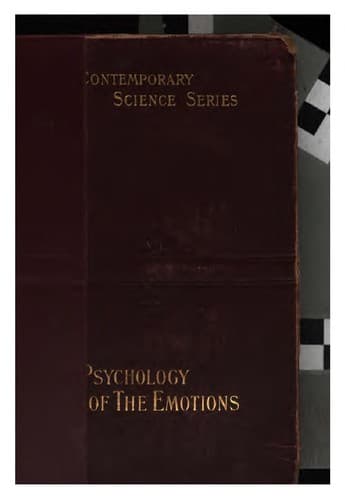
The Psychology of the EmotionsRibot, Th. (Théodule)
Science
The Psychology of the Emotions
Ribot, Th. (Théodule)
Emotions
That tastes are not to be argued about is a platitude which has
been worn threadbare for centuries past. Taken literally, it would
reduce disgust to a purely intellectual manifestation, with no
biological bearing; it would deprive it of all specific character,
and utterly eliminate it as an instinct. This, however, is a
merely superficial position. Contradictions in taste may be
compared with contradictions in morality. Variations in manners
and customs, according to race, epoch, country, and even caste, do
not exclude the existence of a law which has this characteristic
common to all cases—that it is derived from the conditions of
existence of each group, and is by that right imposed on it. In
the same way, disgust exists everywhere, under one form or
another, as a protective instinct. The question is complicated, in
man, by his intellectual development, and the consequent
modification, transformation, or even suppression of this
instinct. Between reasoned knowledge and instinctive tendency a
battle has been fought, in which the victory inclined sometimes to
one side, sometimes to the other. We know the repugnance of
animals towards a change of food. The same thing is seen in
children, and in the inferior races, when not pressed by
necessity. Plasticity grows with civilisation.
We may add to this the necessity for new adaptations; thus, in a
besieged town, people devour unclean food; the instinct of
physiological conservation is a “divided house,” where the positive
form struggles against the negative with results, varying in
different individuals. To this antagonism between primitive instinct
and more complex rational motives let us add the influence of
imitation and of fashion, and there will remain few or no
unexplained exceptions.
As for the _origin_ of this instinct, if we accept the hypothesis of
acquired modifications, we may say that the animals and men best
fitted for abstaining from hurtful substances, have _ipso facto_
better chances of survival, and that they have been able to transmit
to their descendants certain qualities which became fixed and
organised as an innate tendency. Whether or not we admit this
hypothesis does not matter, our only aim being to remind the reader
that disgust is not a capricious and irrelevant phenomenon, but has
its roots in the unconscious depths of our organisation.
CHAPTER II.
FEAR.
Public-domain text, read in full here on John Shaqi.
Reviews
Reviews
No reviews yet
Be the first to share your thoughts on this work.
Elsewhere in the archive
Join the Discussion
Join the discussion
Sign in to leave a comment or review.
Sign InorCreate an account