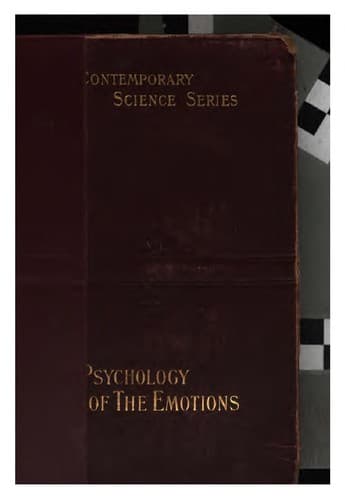
The Psychology of the EmotionsRibot, Th. (Théodule)
Science
The Psychology of the Emotions
Ribot, Th. (Théodule)
Emotions
1. The essential, principal, fundamental cause which, after the
period of physiological incubation, gives a determinate direction to
the tendency is constitution, temperament, character. It may be
admitted, at least theoretically, that _all_ tendencies exist,
actually or potentially, in every one of us. In ordinary cases, one
or more predominate. Contemporary research has familiarised us with
the fact of the varieties of memory. Such and such a person has an
excellent one for figures, or music, or colour, or form, but only
moderate for everything else. This is a natural gift singularly
capable of being developed by exercise. This fact has its equivalent
in the motor order, or that of tendencies: there exist natural
dispositions only wanting an opportunity to become preponderant, and
morbid conditions are the culture-medium which favours their
development. The most violent tendency has its source in normal
life. “There is,” says Gall, “an inclination gradually rising from
the pleasure of seeing anything killed to the most overpowering
desire to kill.” This is not put strongly enough; it is possible to
pass, by imperceptible gradations, from the extreme case to the
normal state in the following order: the pleasure of killing, the
overpowering desire to kill, the pleasure of looking on at killing
(the sight of a murder, gladiatorial combats, etc.), the pleasure of
seeing the blood of animals shed (bull-fights, cock-fights, etc.),
the pleasure due to the representation of violent and bloodthirsty
melodramas (this is only in appearance, but the stage always
presents a momentary illusion of reality); lastly, the pleasure of
reading bloodthirsty novels, or hearing accounts of murders, which
is purely an affair of the imagination. We thus pass from the act to
the perception, the simulacrum, the mere image suggested by signs
read or heard. I do not wish to assert, assuredly, that the
spectators of the drama or readers of the novel are all potential
murderers; but, as there are other men to whom such sights and such
reading are abhorrent, we must recognise certain differences of
natural disposition. Now the peculiarity of retrogression (or
degeneration) is to act on the line of the strongest attraction or
the least resistance, which is a characteristic of reflex action and
the opposite of the inhibitive will, which acts on the lines of
weakest attraction and strongest resistance.
Public-domain text, read in full here on John Shaqi.
Reviews
Reviews
No reviews yet
Be the first to share your thoughts on this work.
Elsewhere in the archive
Join the Discussion
Join the discussion
Sign in to leave a comment or review.
Sign InorCreate an account