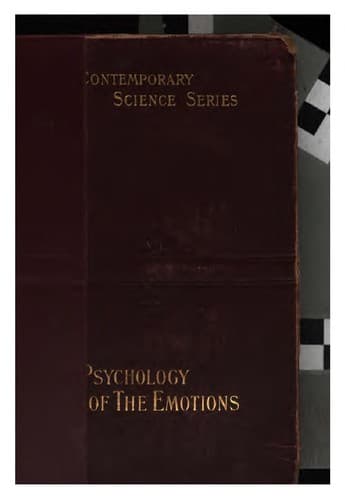
The Psychology of the EmotionsRibot, Th. (Théodule)
Science
The Psychology of the Emotions
Ribot, Th. (Théodule)
Emotions
The psychology of imitation does not form part of our subject.
Baldwin has made an excellent study of it (_Mental Development in
the Child and Race_, pp. 263-366). He defines it as "a
sensori-motor reaction, which finds its differentia in the single
fact that it imitates; that is, its peculiarity is found in the
locus of its muscular discharge. It is what I have called a
‘circular activity’ on the bodily side,—brain-state due to
stimulating conditions, muscular reaction which reproduces or
retains the stimulating conditions,—same brain-state again, due to
same stimulating conditions, and so on." Imitation appears early
in the child, at fifteen weeks (Preyer) or four months (Darwin).
Are we to consider it as an instinct? Popular opinion is inclined
to do so, as are also several psychologists—Stricker, James, and
others. The contrary is maintained by Preyer, Bain, Sully, and
Baldwin—a view I am myself inclined to take. Imitation does not
present the true characteristics of an instinct; it is not adapted
at the first attempt; it gropes its way, it is tentative, it fails
again after success, it retrogrades, or progresses but slowly. It
is an ideo-motor reflex; it takes its place above instinct (a
blind and innate tendency inferior to the voluntary activity for
which it prepares the way), because it is the first attempt at
convergence towards an end.
It manifests itself in animals forming aggregates (not societies),
such as a flock of sheep, or a pack of dogs who run, stop, bark all
at the same time, through a purely physical impulse of imitation: in
man, infectious laughter or yawning, walking in step, imitating the
movements of a rope-walker while watching him, feeling a shock in
one’s legs when one sees a man falling, and a hundred other
occurrences of this kind are cases of physiological sympathy. It
plays a great part in the psychology of crowds, with their rapid
attacks and sudden panics. In nervous diseases, there is a
superfluity of examples: epidemics of hysteric fits, convulsive
barking, hiccup, etc. I omit the mental maladies (epidemics of
suicide, double or triple madness) since we are only considering the
purely physiological stage.
To sum up, sympathy is originally a property of living matter: as
there is an organic memory and an organic sensitiveness, being those
of the tissues and ultimate elements which compose them, there is an
organic sympathy, made up of receptivity and imitative movements.
The _second phase_ is that of sympathy in the psychological sense,
necessarily accompanied by consciousness; it creates, in two or more
individuals, analogous emotional states. Such are the cases in which
we say that fear, indignation, joy or sorrow are communicated. It
consists in feeling an emotion existing in another, and is revealed
to us by its physiological expression. This phase consists of two
stages.
Public-domain text, read in full here on John Shaqi.
Reviews
Reviews
No reviews yet
Be the first to share your thoughts on this work.
Elsewhere in the archive
Join the Discussion
Join the discussion
Sign in to leave a comment or review.
Sign InorCreate an account