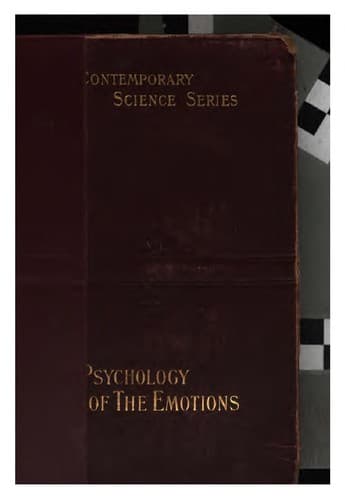
The Psychology of the EmotionsRibot, Th. (Théodule)
Science
The Psychology of the Emotions
Ribot, Th. (Théodule)
Emotions
Anatomy and physiology are not the only sciences concerned in this
question; for if the existence of these superposed centres,
connected with each other, though distinct in function, were
thoroughly established, this would give us certain landmarks, and
lay down fixed conditions, or stages, in the development of sexual
emotion, which may result from a state of the organs (instinctive
form) or from an external perception, or from a pure representation
(imaginative love). In the absence of an anatomical basis which
might serve for the normal psychology of the subject, and still
better for the comprehension of the pathological facts, let us
follow the evolution of sexual love so far as observation enables us
to do so. It has already been sketched in the Introduction, but too
briefly for our present purpose.
2. We have distinguished, in this psychological evolution, three
principal periods: the instinctive, the emotional, and the
intellectualised.
Taking the question at its remotest origin, some naturalists and
philosophers assert that the equivalents of sexual attraction exist
in living beings devoid of nervous systems, in vegetable or animal
micro-organisms. “It is curious,” says Balbiani, “to find, in beings
who from their small size, and the external simplicity of their
organisation, have been placed by all zoologists at the furthest
limit of the animal world, actions denoting the existence of
phenomena analogous to those by which the sex-instinct manifests
itself in a great number of metazoa.... Thus, with the paramæcids,
at the moment of propagation ... a higher instinct seems to govern
these little animals; they seek and pursue each other, they go from
one to another, feeling each other with their cilia, cling to one
another for some instants in the attitude of sexual approach, and
then let go in order to seize each other again. These singular
games, by which these animalcules seem in turn to provoke one
another to the act of copulation, often last for several days before
the act becomes definitive.” Other facts of the same nature have
been cited. Finally, it has been said that “the coupling of the two
sexual elements is analogous to the coupling of the two animals
whence these elements are derived: the spermatozoid and the ovule do
on a small scale what the two individuals do on a large one; the
spermatic element, in directing itself towards the ovule which it is
to fertilise, is animated by the same sexual instinct which guides
the complete being towards the female of the same species.”[158]
-----
Footnote 158:
Public-domain text, read in full here on John Shaqi.
Reviews
Reviews
No reviews yet
Be the first to share your thoughts on this work.
Elsewhere in the archive
Join the Discussion
Join the discussion
Sign in to leave a comment or review.
Sign InorCreate an account