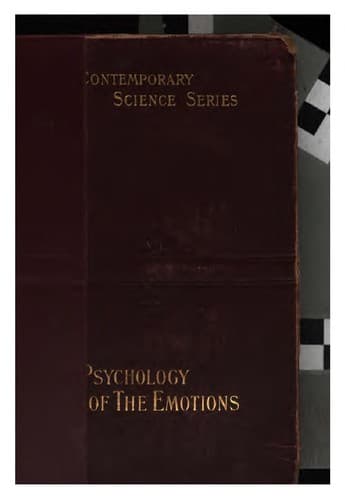
The Psychology of the EmotionsRibot, Th. (Théodule)
Science
The Psychology of the Emotions
Ribot, Th. (Théodule)
Emotions
This evolutionary moment gives the complete type of love. As it goes
on, a breach of equilibrium is produced at the expense of the
physiological and instinctive elements, which gradually efface
themselves before a more and more intellectualised image.
Certainly, there lies at the root of all love the unconscious search
for an ideal, but for an ideal perceived in a concrete, personal
form, incarnate for the moment in an individual. By a process of
mental abstraction similar to that which draws from perceptions the
most general ideas, the concrete image is transformed into a vague
scheme, a concept, an absolute ideal, and we have a purely
intellectual, Platonic, mystical love; the emotion is totally
intellectualised. Let us remark that this last stage of evolution is
not so very rare. Not only do we meet with it sporadically, but it
has been fixed and expressed, at certain moments of history, in
institutions, such as the chivalric love, of which Geoffrey Rudel
seeking the Lady of Tripoli is the most perfect example; the
troubadours, the Provençal Courts of Love, deciding that true love
cannot exist in marriage, and excludes all cohabitation, etc. We
must not, however, allow ourselves to be misled by appearances.
Platonic and mystic lovers have always maintained that their
sentiment is perfectly pure, and has nothing in common with the
senses; the contrary opinion seeming to them a profanation and a
sacrilege. Yet how could love exist without physical conditions,
however attenuated we may suppose them? If they are wanting, all we
have or can have is a purely intellectual state, the representation
of an ideal conceived but not felt. Besides, we have more
satisfactory evidence than suppositions and arguments; facts of
tolerably frequent occurrence show how rapidly we may fall from the
ideal plane. It is only because all the circumstances are in its
favour that the fall is so easy.[160]
Footnote 160:
For some curious observations on this point see especially Moreau
(of Tours), _Psychologie morbide_, pp. 264-278.
Public-domain text, read in full here on John Shaqi.
Reviews
Reviews
No reviews yet
Be the first to share your thoughts on this work.
Elsewhere in the archive
Join the Discussion
Join the discussion
Sign in to leave a comment or review.
Sign InorCreate an account