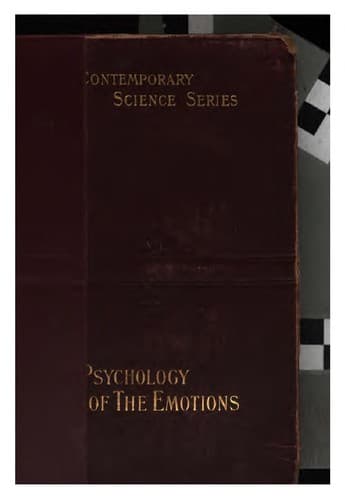
The Psychology of the EmotionsRibot, Th. (Théodule)
Science
The Psychology of the Emotions
Ribot, Th. (Théodule)
Emotions
Æsthetic emotion has its origin in a surplus of activity expending
itself in a particular direction, under the influence of the
creative imagination; and it preserves this fundamental character
from the drawings scratched on flints by quaternary man, or the
symbolic dances of savages, through the classic ages, to the
quintessential refinements of the decadents. It is true that all are
not disposed to admit this: a person of delicate artistic
temperament, brought up in a very cultured environment, and suddenly
thrown into the midst of savage æsthetics, would deny any community
of nature, but in this he would be mistaken. Those centuries which
had no sense of evolution, of the continuity of development (the
seventeenth and eighteenth), could see nothing in the origin of art
but incomprehensible crudities, not worth notice. The transition
from simplicity to complexity took place through the accumulation of
knowledge, of ideas, and technical skill, and of causes or occasions
of new ways of feeling: thus were formed juxtaposed aggregates
acting by quality and quantity. This progress from simplicity to
complexity is seen better than anywhere else in the development of
the feeling for music, the most emotional of all the arts.
The religious sentiment is not of simple origin. It results: (1)
from the fusion of two primary emotions—fear, and love in the larger
sense (tender emotion); it is therefore a binary compound; (2) from
a process of evolution which we shall have to follow in detail and
which depends on intellectual conditions: predominance, first, of
images, then of inferior concepts, then of superior concepts. Here,
too, the continuity escapes the notice of many who do not see the
bond connecting fetichism with the most idealistic of religions. How
many travellers and ethnographers, after having ascertained the
existence, among a given tribe, of magic, amulets, funeral rites,
seriously affirm that these people are devoid of all religious
feelings! It is because for them complex and highly organised forms
are the only ones that count, and because they are accustomed to
think of religious feelings as formulated by the great established
religions.
II. _Evolution in heterogeneous form._—The primary feeling is
transformed to such a degree as to become unrecognisable, and can,
in many cases, only be recovered by laborious analysis. This case
resembles that of the morphological development of animals: the
forms of the adult give no hint of the forms of embryonic and fœtal
life.
The best example I can give is the genesis of the benevolent
emotions, which, however, will be more suitably placed in the next
chapter. We can, however, examine another case.
Public-domain text, read in full here on John Shaqi.
Reviews
Reviews
No reviews yet
Be the first to share your thoughts on this work.
Elsewhere in the archive
Join the Discussion
Join the discussion
Sign in to leave a comment or review.
Sign InorCreate an account