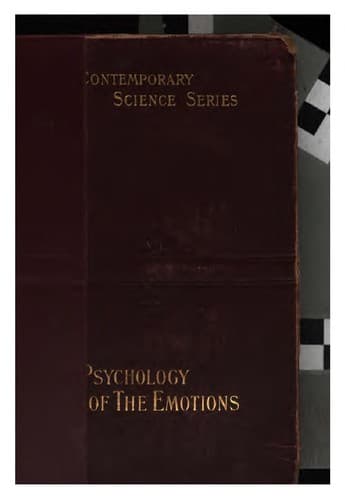
The Psychology of the EmotionsRibot, Th. (Théodule)
Science
The Psychology of the Emotions
Ribot, Th. (Théodule)
Emotions
1. Sexual approach results from one particular instinct; it unites
two individuals only: can we consider it as the embryo of a society?
“Around sexuality are co-ordinated the altruistic instincts of which
the animal is capable.” This formula of Littré’s needs defining with
more precision. First, in the immense majority of cases the
connection is not lasting; the blind instinct satisfies itself, and
all is over. Higher up there are more permanent forms, such as
polygamy and polyandry; but these small communities founded on
sex-attraction are closed, and have no power of radiation or
extension, no future. Higher still we find monogamy, as among
wolves, many birds, etc.; but the monogamic aggregate is still more
of a close corporation than the others. Let us note, in passing,
that these two forms, polygamy and monogamy, are distributed through
the animal world in an apparently fortuitous manner, having no
relation to the intellectual development—as, for instance, the
monogamy of the stork and the polygamy of the monkey.
Finally, this first stage yields us no result, tending rather
towards social restriction than social extension.
2. Maternal love is of much greater importance. In domestic
societies it is the universal and permanent element, the vital bond.
This emotion is so widespread, so well known, we might say so trite,
that it seems to involve no mystery, and yet, if we descend into
animal psychology, we find nothing more enigmatical. The development
of sympathy and intelligence partly explains it in the human species
and the higher animals; but in the lower orders the difficulty
becomes extreme. Yet it shows itself among the annelids, the
crustacea, the mollusca, and even the echinoderms, which carry their
eggs about adhering to their bodies. Frequently it shows itself as a
feeling which, though vague, is tenacious, devoted, heroic. We do
not indicate all the difficulties of the question, as for instance:
How can an insect take such care of its eggs when it cannot
recognise its own form in a creature which in nowise resembles
itself, and has not even a living form?[169]
-----
Footnote 169:
For a detailed study of this question see Espinas, _Les Sociétés
Animales_ (2nd ed.), pp. 334 _et seq._, 411 _et seq._, 444 _et
seq._
-----
Public-domain text, read in full here on John Shaqi.
Reviews
Reviews
No reviews yet
Be the first to share your thoughts on this work.
Elsewhere in the archive
Join the Discussion
Join the discussion
Sign in to leave a comment or review.
Sign InorCreate an account