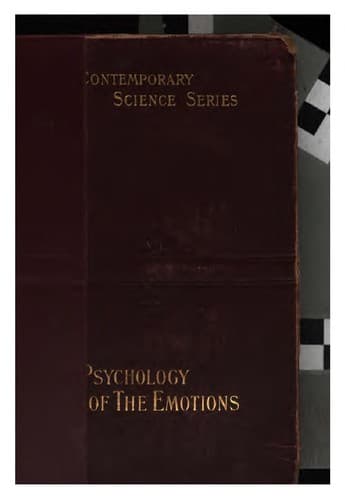
The Psychology of the EmotionsRibot, Th. (Théodule)
Science
The Psychology of the Emotions
Ribot, Th. (Théodule)
Emotions
The contrary is the case with the carnivora; they are well armed,
and need ample space in which to hunt down their prey, so that it is
to their advantage to live in isolation, except in those cases
already mentioned, where they associate together for a difficult
chase, or for defence against a dangerous enemy.[174]
-----
Footnote 174:
Herbert Spencer, _Psychology_, ii. § 503 _et seq._
-----
We may add that there are animals which, as they find it to their
advantage or otherwise, live alternately in communities or isolated.
“Certain sociable birds in Australia build bowers of branches, where
they assemble in great numbers during the day. In pairing-time the
society is broken up, and each couple retires by itself to construct
its own separate nest. While the temporary families last there is no
longer any assemblage, nor any life in common; it only begins again
when the young are able to try their wings. This is only one of
numberless examples which might be mentioned.”[175]
-----
Footnote 175:
Houssay, _Revue philosophique_, May 1893, p. 487.
-----
In short, gregarious life depends on stature, strength, means of
defence, kind and distribution of food, and mode of propagation.
Derived from necessity, this habit of life in common creates a
solidarity which is not mechanical and external, but psychological:
the sight, the touch, the smell of his companions constitute in each
individual a part of his own consciousness, of which he feels the
want in its absence; the distressed state and the lamentations of an
animal separated by chance from the herd are well known.
Here a disputed question suggests itself. It has been already
settled by implication in the course of the statements already made,
but it cannot be thus treated retrospectively and merely in passing.
For the moment I may confine myself to indicating it. If we compare
family societies and gregarious societies, what relation is there
between them? We find ourselves in presence of two opinions or
theories—one in favour of unity, the other of duality.
The first, the most ancient and widespread, derives social life
from domestic life. The family is the social molecule: by its
increase are formed aggregates of a more or less complex
character, whose life in common creates a solidarity and an
exchange of services—_i.e._, the conditions of a community.
The second admits two groups of irreducible feelings and tendencies,
mutually independent, though there are points of contact. The social
instinct is not derived from the domestic feelings, while the latter
are not derived from the social feelings. They are distinct by
nature, having their respective sources in the attraction of like
for like, irrespective of sex, and in the sexual appetite and the
development of the tender emotions.
Public-domain text, read in full here on John Shaqi.
Reviews
Reviews
No reviews yet
Be the first to share your thoughts on this work.
Elsewhere in the archive
Join the Discussion
Join the discussion
Sign in to leave a comment or review.
Sign InorCreate an account