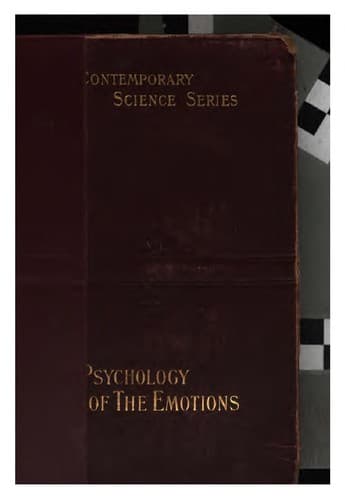
The Psychology of the EmotionsRibot, Th. (Théodule)
Science
The Psychology of the Emotions
Ribot, Th. (Théodule)
Emotions
1. The evolution of the family has certainly not proceeded in all
places in the same way, a circumstance which always permits the
critic to oppose facts to the view he is combating. A disease
inherent in the human mind induces most writers to try and refer
everything to _one_ formula, to impose on facts that perfect unity
which, in such matters, does not appear very probable. Those who
assign the greatest length of time to the evolution of the family
admit three stages: promiscuity, matriarchate, patriarchate.
The period of primitive promiscuity (Bachofen, MacLennan,
Girard-Teulon, etc.) is contested and rejected by many authorities.
In any case, it does not seem as if we could establish the rule
without a great number of exceptions. Not to speak, however, of
archaic institutions which have been interpreted in this sense, and
as survivals, there are still certain Tartar populations which
approach this stage. At Hawaii, the individual was related to the
whole horde, age alone determining the relationships: every one
called all the old people indiscriminately grandfather and
grandmother; all those who, as far as age went, might be his
parents, father and mother; all those of his own generation,
brothers and sisters; and so on for sons and daughters, grandsons
and grand-daughters. These five terms expressed all known degrees of
kinship. We may note, in passing, that a very weak psychological
argument has been put forward in order to disprove the existence of
this period—viz., that the natural jealousy of man would have
rendered promiscuity impossible, at least for any length of time.
Those who have hazarded such reasoning have been too ready to judge
primitive man by civilised standards. However this may be, such a
mass, without individual relationships, is rather a society than a
family; or rather, it is an undifferentiated state, which might be
compared to the lowest form of animal societies (the nutritive),
which also is undifferentiated.
Public-domain text, read in full here on John Shaqi.
Reviews
Reviews
No reviews yet
Be the first to share your thoughts on this work.
Elsewhere in the archive
Join the Discussion
Join the discussion
Sign in to leave a comment or review.
Sign InorCreate an account