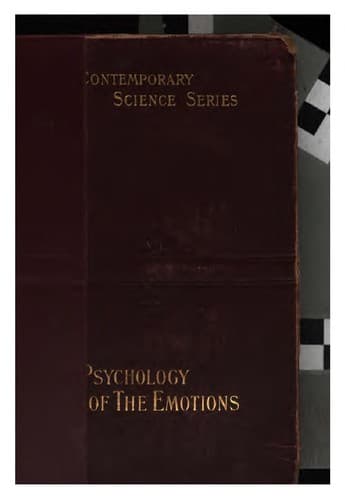
The Psychology of the EmotionsRibot, Th. (Théodule)
Science
The Psychology of the Emotions
Ribot, Th. (Théodule)
Emotions
It is an observed fact that a man attaches himself to another rather
in proportion to the services he renders than to those he receives
from him. There is, in general, a stronger current of benevolence
passing from the benefactor to his _protégé_ than _vice versâ_.
Common opinion considers this illogical: from the point of view of
reason, it is so—not from that of feeling; and the preceding
analysis even shows that it _must be_ so, because the benefactor has
put more of himself into the recipient of his bounty than the latter
can do to him. Thus, in many persons, gratitude needs to be
supported by reflection.
If we are ill-disposed towards any one, the best and surest remedy
against this incipient aversion is to render him some service.
Conversely, the person who refuses all our benefits and obstinately
avoids them becomes an object of indifference, or even hatred.
“During the proscriptions of Marius and Sulla,” says Friedmann,
“there were many sons who, out of fear, gave up their father, but it
was never known that a father had denounced his son; a fact that
somewhat startled the Roman moralists, who were unable to explain
it.” The explanation is involved in the constitution of the Roman
family, by which the father could confer many benefits on the son,
whereas the son was entirely dependent on the father, and could do
nothing for him.
Many other incidents might be cited to justify the accuracy of the
preceding analysis. Such is the mechanism by means of which our
emotional self succeeds in externalising, in alienating itself; but
this could not be done were there not at the origin and
starting-point a primary tendency, already studied under the name of
tender emotion. It is clear, also, that beneficence is a generic
term designating forms which vary according to circumstances:
charity, generosity, devotion, etc.
The extension and heightening of the feeling of beneficence have
taken place slowly, and owing to the work of certain men who deserve
to be called _discoverers_ in morals. This expression may sound
strangely in some ears, because they are imbued with the theory of
an innate and universal knowledge of good and evil imparted to all
men at all times. If we admit, on the contrary,—as observation
teaches us to do,—not a ready-made, but a growing morality, it must
necessarily be the discovery of an individual or group of
individuals. Every one admits the existence of inventors in
geometry, in music, in the plastic and mechanical arts; but there
have also been men in moral disposition far superior to their
contemporaries, who have initiated or promoted reform in this
department. Let us note (for this point is of the highest
importance) that the _theoretic_ conception of a higher moral ideal,
of a step in advance, is not sufficient; it needs a powerful emotion
leading to action, and, by contagion, communicating its own impulse
to others. The onward march is proportioned to what is _felt_, not
to what is understood.
Public-domain text, read in full here on John Shaqi.
Reviews
Reviews
No reviews yet
Be the first to share your thoughts on this work.
Elsewhere in the archive
Join the Discussion
Join the discussion
Sign in to leave a comment or review.
Sign InorCreate an account